

About Shri Muttettaraaya Swamy Temple, Muttatti
Shri Muttettaraaya Swamy Temple is the spiritual heart of Muttatti, a small riverside settlement in Mandya district surrounded by the forests and rocky landscape of the Basavanabetta region. Situated on the left bank of the River Kaveri, about 45 km southeast of Malavalli, Muttatti brings together three experiences that are rarely found so closely intertwined: an active village shrine, a powerful Ramayana tradition and the natural beauty of the Kaveri valley. The Mandya District Government itself identifies Muttatti as a destination of historic, religious and natural significance.
The presiding deity is Muttettaraaya, a form of Lord Hanuman worshipped as the guardian and principal deity of the locality. The name and identity of the shrine are closely connected with a local Ramayana legend involving Sita and Hanuman. According to this tradition, Shri Rama, Lakshmana, Sita and Hanuman stayed in this region while returning towards Ayodhya. During Sita's bath in the Kaveri, her nose ornament is said to have fallen into the river. Hanuman, responding to her request, is believed to have extended his tail into the water, churned the river and recovered the ornament. Sita then blessed Hanuman and is traditionally believed to have given him the name Muttettiraya and a special place as the guardian deity of Muttatti.
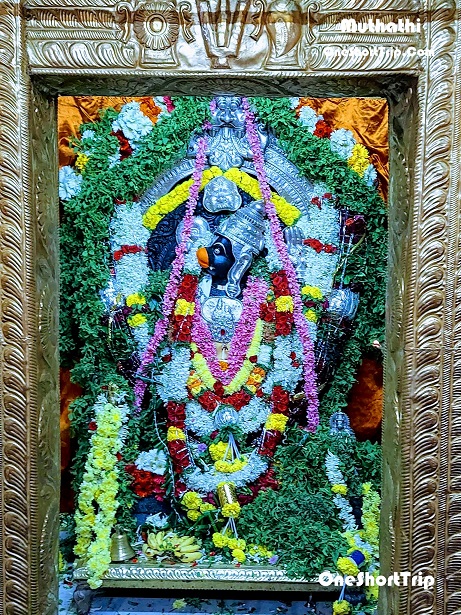
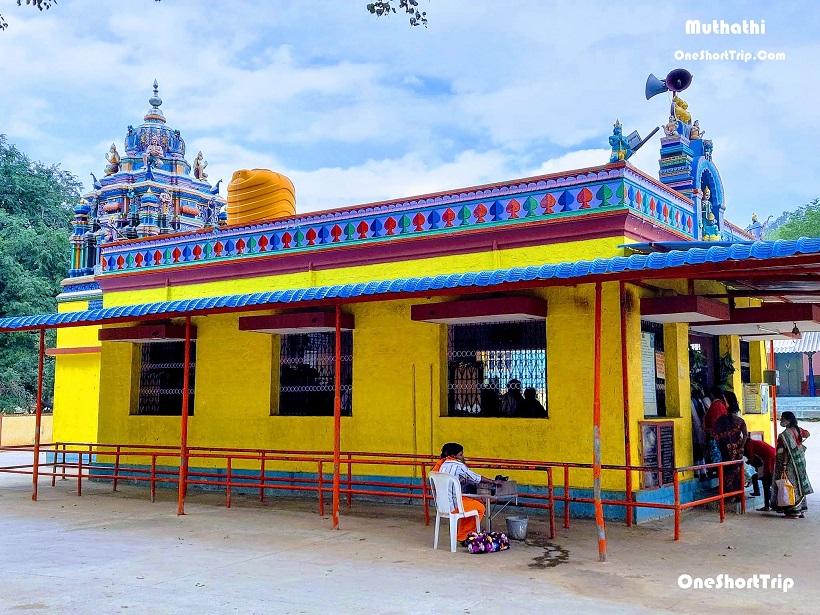
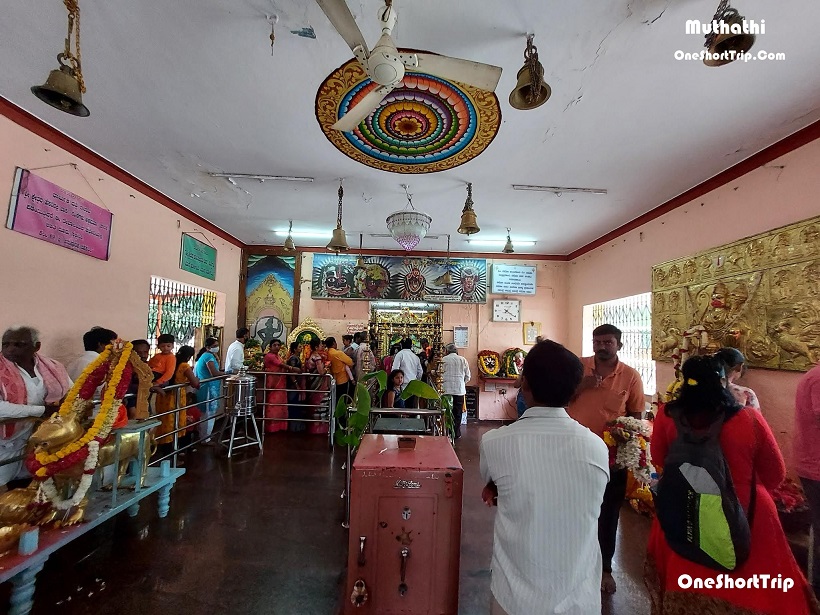
The Legend Behind the Name Muttatti
The story of Muttatti is not simply a legend attached to an old temple; it explains why the settlement continues to be associated with Hanuman in such a distinctive way. The central episode concerns Sita's lost nose ornament and Hanuman's extraordinary effort to retrieve it from the Kaveri. In the local telling, the action of disturbing or churning the river while searching for the ornament became part of the identity of the place itself.
As with many sacred places associated with the Ramayana, this account belongs to the realm of religious tradition and local belief rather than independently established historical evidence. Its importance, however, is very real in the cultural life of Muttatti. The story gives the temple its distinctive identity and explains why Hanuman is not merely another deity worshipped here, but the central guardian figure of the settlement.
Why Hanuman Is Worshipped as Muttettaraaya
The name Muttettaraaya is inseparable from the temple's local tradition. Devotees understand Hanuman here as a protective deity whose presence is connected with the sacred history of Muttatti. Rather than presenting the shrine simply as another Hanuman temple in Karnataka, the local tradition gives Muttettaraaya a specific relationship with Sita, the Kaveri and the settlement itself.
This is one reason the temple has continued to attract both pilgrims and travellers who are interested in the lesser-known sacred landscapes of Karnataka. The religious experience is closely tied to the surrounding geography: the river, forest, rocky terrain and village all form part of the setting in which the Muttettaraaya tradition is understood.
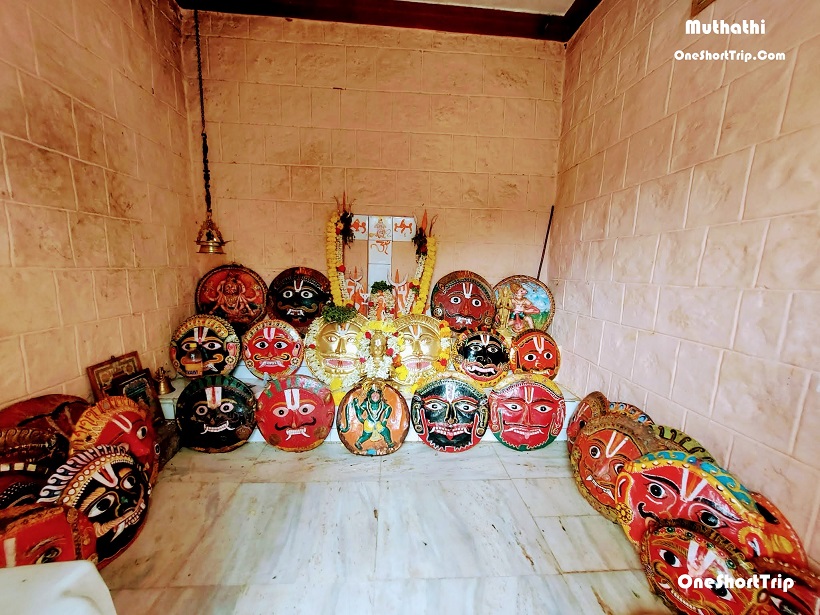
Muttatti and the Ramayana Tradition
Muttatti forms part of Karnataka's wider landscape of places that local tradition connects with episodes from the Ramayana. The story here is particularly centred on the journey of Rama, Sita, Lakshmana and Hanuman and their supposed stay beside the Kaveri while returning to Ayodhya. The river therefore becomes more than a geographical feature: within the local sacred narrative, it is the setting for the episode that defines the identity of the village and its guardian deity.
The Mandya District Government describes the Ramayana association as a Puranic tradition and records the story of Sita's nose ornament, Hanuman's recovery of it and Sita's blessing of Hanuman as Muttettiraya. This distinction between tradition and documented history is important when visiting Muttatti: the site's cultural significance comes from generations of belief and worship, even though the Ramayana episode itself is not something that can be established through archaeological evidence.
A Temple Beside the Kaveri
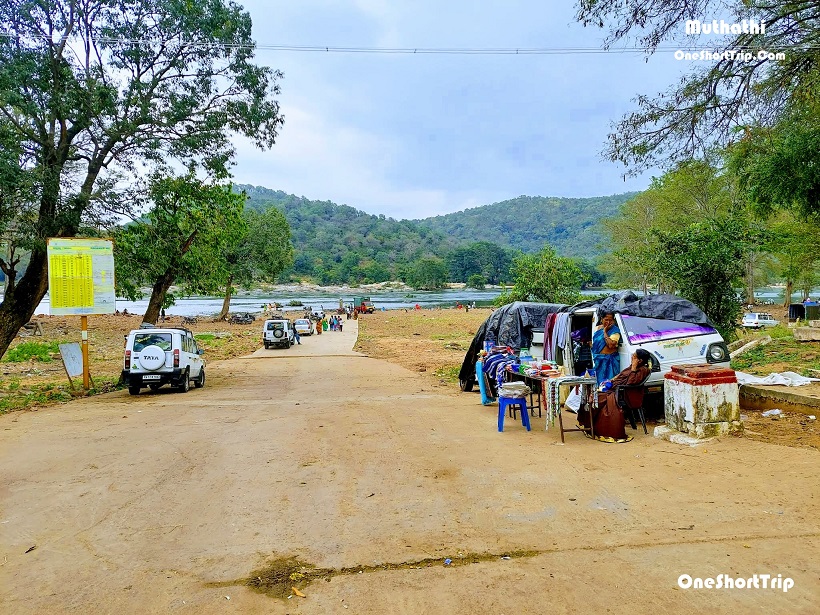
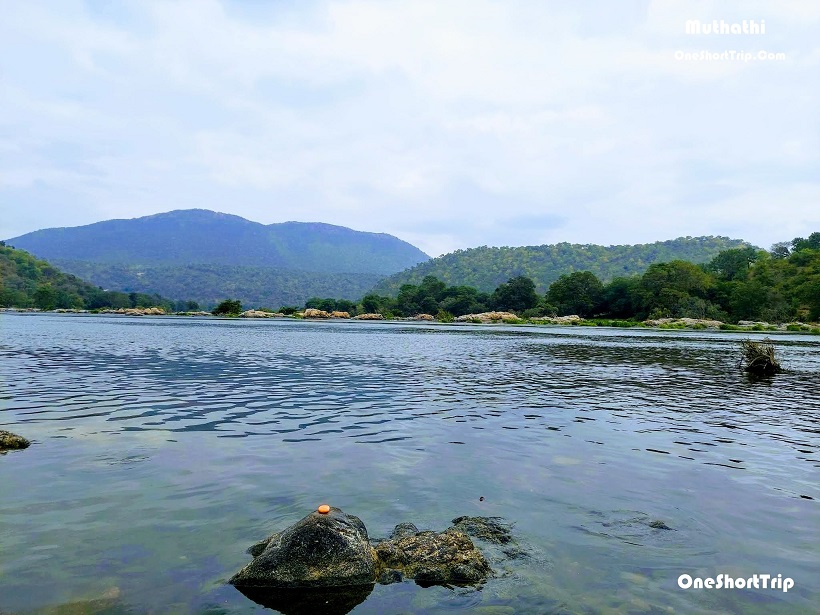
The location of Shri Muttettaraaya Swamy Temple is an important part of the experience. Muttatti stands directly within the Kaveri landscape, with the river forming one of the defining features of the settlement. The temple and village are surrounded by the forested terrain of Basavanabetta, giving the pilgrimage site a very different atmosphere from the large urban temples of Mysuru, Bengaluru or Srirangapatna.
The combination of river and forest is also why Muttatti is often visited as a nature escape rather than exclusively as a pilgrimage destination. Visitors can experience the changing character of the Kaveri valley, from quiet stretches of riverbank to rocky sections and wooded surroundings. The Mandya district administration specifically lists Muttatti under natural/scenic beauty as well as religious and historic tourism.
Muttatti Within the Basavanabetta Forest Landscape
Muttatti lies within the Basavanabetta reserved-forest belt, a landscape known for its dry forest character, hills, rocky terrain and Kaveri river environment. The forest setting changes the character of the temple visit: the shrine is not isolated from nature, but forms part of a much larger landscape in which village life, pilgrimage and the river coexist.
For travellers, this means that a visit should not be planned like a conventional city temple stop. The journey itself is part of the experience. Approaching Muttatti through the forested countryside and reaching the Kaveri-side settlement creates a sense of transition from ordinary road travel into a quieter rural and sacred environment.
The Religious Importance of Muttettaraaya
Muttettaraaya is worshipped as the kshetra deity or guardian presence of Muttatti. The temple's importance therefore extends beyond the physical structure. For local devotees and pilgrims, visiting the shrine is a way of acknowledging Hanuman's protective association with the place and its sacred story.
The temple's popularity becomes especially visible during its annual Muttettiraya Jatre. The Mandya District Government records that the festival, held during the month of Shravana, brings devotees in large numbers. The scale of the gathering demonstrates how a comparatively small rural shrine can become an important regional pilgrimage centre during its principal festival.
The Muttettiraya Jatre
The annual Jatre is one of the most significant cultural occasions connected with Muttatti. It transforms the normally quiet riverside settlement into a much busier pilgrimage destination, bringing together devotees, traditional practices and the community's continuing relationship with Muttettaraaya.
The festival is particularly important because it demonstrates that Muttatti is not simply a historical location attached to an old legend. It remains a living religious landscape in which the traditions surrounding Hanuman continue to be practised. Visitors interested in experiencing the cultural side of Muttatti may find the Jatre especially significant, although festival days are considerably busier than ordinary visits.
Muttatti Is More Than a Temple Visit
One of the most distinctive aspects of Muttatti is the way its attractions overlap. A traveller can come for Shri Muttettaraaya Swamy Temple, spend time understanding the Ramayana tradition, experience the Kaveri landscape and explore the surrounding forested countryside during the same outing. That combination makes Muttatti particularly suitable for travellers looking for a quieter alternative to the better-known weekend destinations around Bengaluru and Mysuru.
It is also important to understand that the river is not simply a recreational backdrop. Muttatti is a sacred landscape, and the Kaveri is central to the temple's founding legend. Visitors should therefore treat the riverbank, temple premises and surrounding forest with the same respect expected at a pilgrimage site.
Chikka Muttatti: A Nearby but Different Shrine
Travellers should not confuse the main Muttatti shrine with Chikka Muttatti, a separate nearby location on the same broader route. The Mandya District Government records another Muttettiraya temple at Chikka Muttatti, where a stone Garuda pillar bearing a carving of Hanumantha is worshipped. Its own Jatre includes distinctive local practices such as Hulivahanotsava.
The distinction matters when planning a trip because both places are associated with Muttettiraya/Hanuman worship and similar Ramayana traditions. The destination covered on this page is Shri Muttettaraaya Swamy Temple at Muttatti, the riverside settlement on the Kaveri in the Basavanabetta forest landscape.
A Sacred Landscape Shaped by River, Forest and Belief
Muttatti's character comes from the relationship between its three defining elements: the Kaveri, the surrounding forest and the Muttettaraaya tradition. Remove any one of them and the place becomes much harder to understand. The river explains the central legend, the forest gives the settlement its distinctive setting, and the temple provides the spiritual focus around which the local identity has developed.
That layered identity is what makes Muttatti interesting for travellers. It is not a monumental temple complex with elaborate architecture competing for attention. Its appeal lies instead in the story of the deity, the continuity of local worship, the Kaveri landscape and the feeling of arriving at a sacred village surrounded by forest.
Why Visit Shri Muttettaraaya Swamy Temple?
Visit Muttatti if you want to experience a lesser-known Karnataka pilgrimage site where mythology and landscape are inseparable. The temple offers a very different experience from major urban shrines: the focus is on Hanuman as Muttettaraaya, the Ramayana tradition surrounding Sita's ornament, the Kaveri river and the living religious identity of the village.
For a traveller planning a wider Mandya or Cauvery-region circuit, Muttatti can also become one of the more memorable stops because it combines spiritual interest with rural scenery. It is particularly appealing to visitors who prefer destinations where the journey, setting and local traditions are as important as the monument itself.
Muthathi Temple Seva Details
Muthathi Temple Entry Fees: No Entry Fees
Muthathi Temple Timings:
Mon – Sun: 06:00 A.M to 7:30 PM
During Dhanurmasa: 04:30 AM to 8:30 PM
Poorna Hunnime: 05:00 AM to 8:30 PM
Best time to Visit Muthathi: During winter, and:
- Car festival (Jatre)
- Hanuma Jayanthi in October
- Sri Rama Jayanthi in July
- Gokulashtami in August
Muthathi Temple Seva Details:
- Prasada Naivedhya – ₹10
- Archane – ₹10
- Vehicle Pooja (Auto, Scooters) – ₹10
- Vehicle Pooja (Car, Lorry, Bus) – ₹20
- Yantra Kattuvudakke – ₹20
- Abhishekam – ₹50
- Namakarana – ₹50
- Dasana Bidisalu – ₹50
- Dhanurmasa Pooja – ₹200
- Benne Alankara – ₹200
- Dodda Devarige – ₹250
- Marriage – ₹500
Visiting Shri Muttettaraaya Swamy Temple, Muttatti
A visit to Shri Muttettaraaya Swamy Temple is best understood as a combination of pilgrimage, riverside scenery and a journey through the forested countryside of the Kaveri valley. Unlike large temple complexes in major cities, Muttatti has a distinctly rural atmosphere. The temple stands beside the Kaveri within the Basavanabetta forest belt, so the surrounding landscape is an important part of the experience.
Temple Timings
The Karnataka Hindu Religious and Charitable Endowments (HRCE) listing for the Muttatti Anjaneya Temple currently publishes morning hours of 6:00 AM to 9:00 AM, followed by a second session from 10:00 AM to 6:00 PM. These timings are the best current official reference available, but temple schedules can change during festivals, special poojas and local occasions. It is advisable to verify the day's darshan schedule before starting a long journey to Muttatti.
How to Reach Muttatti
Muttatti is in Malavalli taluk of Mandya district, about 45 km southeast of Malavalli. The final approach takes you away from the main urban centres and into the forested Kaveri landscape. This is one reason a private car or taxi is generally more convenient for travellers who want to combine the temple with nearby nature destinations.
From Bengaluru, travellers generally approach the region through the Kanakapura–Halaguru side and continue towards Muttatti. From Mysuru, the journey can be planned through the Malavalli side. Road conditions can vary, particularly on the interior forest stretches, so allow more time than the map distance alone might suggest.
Travelling by Bus or Public Transport
Public transport can be used to reach the broader Muttatti region, although services are less convenient than those available between Bengaluru, Kanakapura, Malavalli and Mysuru. Older travel information describes bus connections towards Sathanur and onward services to Muttatti, but frequencies can change. Travellers using public transport should check the current local bus connection rather than relying on an old timetable.
There is no railway station at Muttatti. If arriving by train, the final part of the journey has to be completed by road. For a temple visit combined with the surrounding Kaveri attractions, a private vehicle is normally the more practical option.
Forest Checkpoints and the Approach Road
The approach to Muttatti passes through forest territory, so visitors should expect a quieter road environment and stretches where mobile connectivity may be unreliable. Forest regulations can also affect movement, particularly during periods of high fire risk, wildlife activity or other restrictions.
Do not treat the forest road as a normal highway. Drive slowly, avoid unnecessary stopping in isolated stretches and follow instructions given at forest checkpoints. Wildlife may occasionally cross roads, and monkeys and other animals can be encountered around tourist areas. Feeding wildlife should be avoided.
Best Time to Visit Muttatti
The most comfortable period for exploring Muttatti is generally from the cooler months into the early summer, when the forest and river landscape can be enjoyed without the intense heat of the peak summer months. October to February is particularly suitable for a relaxed day trip, while the post-monsoon period can bring attractive greenery to the surrounding countryside.
Monsoon and immediately post-monsoon visits can be beautiful, but the Kaveri becomes a more serious safety consideration when water levels and currents increase. Never judge river conditions solely from photographs or from how calm the water appears near the bank.
How Long Do You Need?
Allow roughly 1 to 2 hours for a relaxed temple-and-riverside stop if you are visiting only Muttatti. Travellers who want to spend additional time around the river, have a meal, explore the surroundings or include nearby attractions should plan considerably longer.
Because Muttatti is relatively remote, it makes more sense to plan it as part of a full-day excursion rather than driving a long distance only for a short temple visit. Start early, particularly if travelling from Bengaluru, and keep enough daylight for the return journey through the forest region.
Is Muttatti Suitable for Families?
Yes. Families can enjoy Muttatti because the visit combines a temple, open countryside and the Kaveri landscape. Children may find the forest journey and river setting more interesting than a conventional urban sightseeing stop.
However, children should remain under close supervision near the river and rocky areas. The fact that other visitors are entering the water does not mean conditions are safe. Parents should also prevent children from approaching or feeding monkeys and other wildlife.
Is Muttatti Suitable for Senior Citizens?
The temple itself can be included in a senior-friendly itinerary, provided the journey is paced comfortably. The bigger consideration for older travellers is not the temple but the length of the road journey and the forest terrain around Muttatti.
Senior travellers should avoid unnecessary walking over uneven riverbank rocks and should not attempt steep or slippery paths simply to reach a viewpoint. Carry drinking water, take breaks and keep the temple visit separate from any strenuous outdoor activity.
River Safety at Muttatti
The Kaveri is one of the main reasons people visit Muttatti, but it is also the part of the destination that requires the greatest caution. Water depth, current strength and river conditions can change rapidly. Rocks beside the river can also become extremely slippery.
Do not enter the river at unfamiliar locations, especially during monsoon or when water is flowing strongly. Avoid alcohol near the river, never allow children to approach the water unattended, and follow any instructions or barricades put up by local authorities or forest officials. A scenic riverside visit does not require getting into the water.
What to Carry
- Drinking water and light refreshments
- Comfortable footwear with good grip
- Sun protection such as a hat, sunglasses and sunscreen
- Basic personal medicines
- Power bank because mobile connectivity can be inconsistent
- Cash for small local purchases where digital payment may not be available
- A small bag for carrying waste back out of the forest area
- Rain protection during the monsoon
Temple Etiquette and Dress
Muttettaraaya is a living Hindu shrine, so visitors should dress modestly and behave respectfully within the temple premises. Avoid loud behaviour, smoking and alcohol around the shrine. Follow instructions regarding footwear, photography and movement inside the worship areas rather than assuming that general tourist rules apply.
During busy festival periods, queues and local religious activities can change the normal experience. Give priority to devotees performing worship and avoid obstructing entrances or ritual areas for photographs.
Photography at Muttatti
The surrounding landscape offers excellent opportunities for general travel photography, particularly the Kaveri, forest road and countryside. Inside the temple, however, photography should always follow the instructions of temple authorities. Do not photograph rituals, priests or devotees closely without permission.
Food and Refreshments
Muttatti is a small forest settlement rather than a developed tourist town, so visitors should not depend on a large choice of restaurants. It is sensible to carry water and simple snacks, particularly when travelling with children or seniors. For a proper meal, planning the stop around larger settlements on the route is often more dependable.
Avoid leaving food packets, plastic bottles or other waste around the river or forest. The remote character of Muttatti is part of its appeal, and responsible travel is especially important in a forest environment.
Nearby Chikka Muttatti
Travellers interested in the Muttettiraya tradition can also consider Chikka Muttatti, a separate nearby sacred location on the same broader road. The Mandya District Government records a Muttettiraya temple there with a stone Garuda pillar bearing a carving of Hanumantha that is worshipped by devotees. The site has its own Jatre and distinctive local traditions.
Chikka Muttatti should not be treated as another name for the main Muttatti temple. They are separate locations connected by related Muttettiraya traditions.
Muttatti and Bheemeshwari
Muttatti can be combined with the wider Bheemeshwari and Kaveri-region landscape for travellers interested in nature, forests and riverside experiences. Bheemeshwari is particularly known for its Cauvery-side wilderness setting and outdoor activities, making the two destinations a natural combination for an adventure-oriented day trip.
Because forest roads and activity timings can affect the day's schedule, it is better to choose a realistic combination rather than trying to cover too many distant attractions in a single outing.
Suggested Muttatti Day Trip from Bengaluru
A practical Bengaluru itinerary is to leave early, travel through the Kanakapura–Halaguru side, enter the forest region, visit Shri Muttettaraaya Swamy Temple, spend some time around the Kaveri landscape and then continue towards another nearby nature destination if road and daylight conditions permit.
For travellers who want a more relaxed day, Muttatti itself can be the main destination. This avoids turning the trip into a race between several attractions and leaves enough time for the temple, lunch, photography and the return journey.
Suggested Muttatti + Bheemeshwari Circuit
For a nature-focused outing, combine Muttatti with Bheemeshwari or another approved Kaveri-region nature experience. Begin with the temple in the morning, continue into the surrounding river-and-forest landscape and reserve the afternoon for the nature activity. Check current forest access conditions before finalising the route.
Muttatti During the Muttettiraya Jatre
The Shravana-period Muttettiraya Jatre is the most important festival associated with the temple and brings large numbers of devotees to Muttatti. For pilgrims, festival days can offer a deeper experience of the living tradition; for casual travellers, however, they also mean heavier crowds, more traffic and a very different pace of visiting.
If your priority is peaceful sightseeing and photography, an ordinary weekday is generally a better choice. If your purpose is specifically to witness the religious and cultural traditions of the Jatre, plan well in advance and expect substantial crowds.
A Responsible Way to Experience Muttatti
Muttatti sits in a sensitive combination of sacred and natural environments. Responsible visitors should keep the temple clean, avoid disturbing wildlife, carry their plastic waste back out, respect local worship and never treat the Kaveri as an unrestricted recreational swimming area.
The best experience here is a slower one: arrive without rushing, visit the Muttettaraaya shrine, understand the local Ramayana tradition, spend time appreciating the Kaveri landscape and leave the forest as quietly as you found it.
Why Muttatti Is Worth Visiting
Shri Muttettaraaya Swamy Temple is worth including in a Karnataka travel itinerary because it offers something different from conventional sightseeing. Here, the temple, Ramayana tradition, Kaveri River and forest landscape are connected into one destination. The Mandya District Government itself recognises Muttatti across religious, historic and natural/scenic categories.
For travellers from Bengaluru, Mysuru and the Mandya region, Muttatti works particularly well as a full-day road trip for those who enjoy temples, mythology, riverside landscapes and quieter destinations away from crowded city attractions.


