Sri Tripurasundari Temple, Moogooru – The Sacred Thibbadevi Temple of Mysuru
Sri Tripurasundari Temple at Moogooru, also known as the Thibbadevi Temple, is one of the distinctive Shakti temples in the Mysuru region of Karnataka. Located in Moogooru village of T. Narasipura taluk, the temple is revered as the abode of Goddess Tripurasundari, a powerful form of the Divine Mother. For devotees, the shrine is associated with protection, strength, prosperity and the removal of difficulties, while for travellers it offers an opportunity to experience a lesser-known temple tradition deeply connected with the religious culture of southern Karnataka.
The name Tripurasundari is commonly interpreted as “the beauty of the three worlds.” At Moogooru, the goddess is traditionally understood as the supreme Shakti associated with the combined divine power of Brahma, Vishnu and Maheshwara. She is also widely known locally as Thibbadevi, making both names useful when searching for or travelling to the temple.
What makes the temple particularly fascinating is the combination of devotion, village tradition, mythology and religious coexistence surrounding its history. The temple's origin is traditionally connected with a Muslim palegar named Nawab Baba Saheb, while its annual celebrations preserve a distinctive local tradition known as Chiguru Odoyo Jatre.


The Legend of Thibbadevi and Nawab Baba Saheb
The most distinctive story associated with the Moogooru temple begins several kilometres away from the present shrine, near what is now Hosahalli. According to local tradition, Nawab Baba Saheb was travelling with his army after an expedition when he stopped to rest beside a lake. He is said to have slept beneath a jamun tree with his head resting on a stone.
During his sleep, the Nawab is said to have seen an intense light. When he awoke, he found his soldiers strangely motionless. The goddess Tripurasundari then appeared before him and revealed that he had unknowingly rested his head upon her sacred presence.
As the story is traditionally told, the Nawab initially challenged the goddess because of his own religious beliefs. He took a dried jowar stalk and planted it upside down, declaring that he would accept her divine power if the apparently lifeless stalk produced fresh growth by the following evening.
When he returned, the dried stalk was said to have sprouted. The Nawab accepted the miracle, sought the goddess's forgiveness and requested permission to construct a temple at Moogooru. The story says that the goddess agreed to reside there and promised to defeat the lineage of Mookasura associated with the region.
This story is a local religious tradition rather than a verified historical account. Nevertheless, it remains central to the identity of the temple and explains why the annual sprouting festival continues to be associated with the shrine.
Why Moogooru Is Called the Land of Thibbadevi
The traditional story of the goddess and Mookasura is also connected with the name Moogooru. According to the local account, the goddess promised to destroy the lineage of Mookasura in the area and remain permanently at the village. Over time, the place became associated with the goddess and came to be known as Moogooru or Muguru.
Because of this association, Thibbadevi is not simply the presiding deity of the temple; she is deeply woven into the cultural identity of the village itself. Festivals, processions and village traditions continue to centre around the goddess.

The Chiguru Odoyo Jatre – The Festival of New Sprouting
One of the most unusual traditions connected with Sri Tripurasundari Temple is the Chiguru Odoyo Jatre, traditionally associated with the sprouting of the jowar stalk in the temple's origin legend. The name refers to the appearance of fresh shoots and reflects the agricultural character of the surrounding region.
The festival is traditionally celebrated for three days, generally around the Sankranti period in January or February. One of its most distinctive features is the arrival of goddess images from neighbouring villages. According to local tradition, these deities are regarded as the sisters of Thibbadevi and are brought to Moogooru in ceremonial processions to visit the principal goddess.
The visiting deities are then taken around the village in procession, turning the festival into a community-wide celebration rather than an event confined to the temple premises. The jatre therefore provides a valuable glimpse into the living village traditions of the Mysuru region.
The Temple Architecture
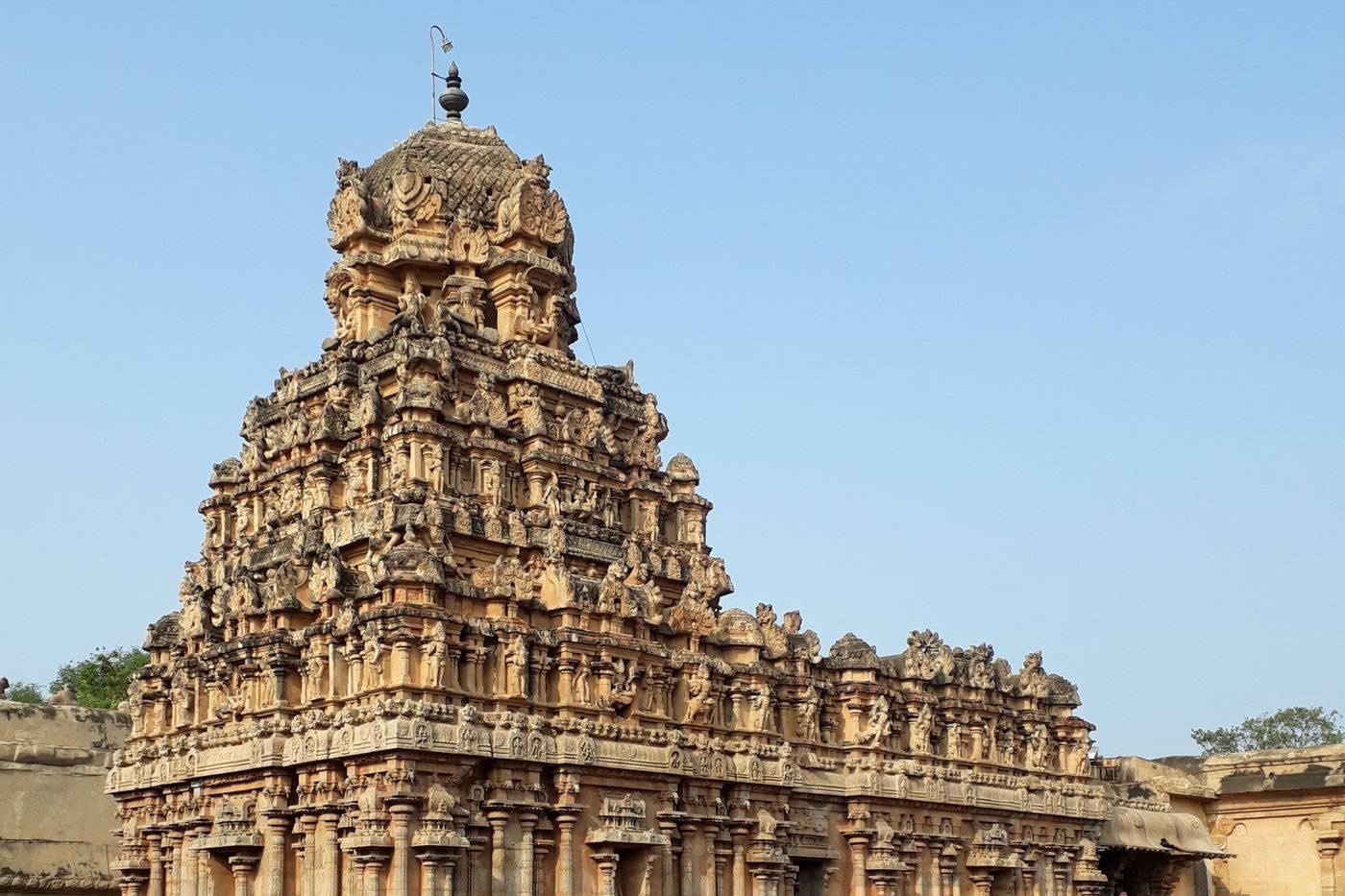
The architecture of Sri Tripurasundari Temple has a character of its own. Rather than relying on an enormous South Indian rajagopura, the temple presents a strong, enclosed appearance with high surrounding walls and a prominent arched entrance. Smaller representations of the goddess decorate portions of the temple exterior, creating a visual connection between the architecture and the deity worshipped within.
A circumambulatory path surrounds the main shrine, allowing devotees to perform pradakshina around the sanctum. The entrance leads towards a mukhamandapa supported by stone pillars, while the vimana rises above the garbhagriha and carries decorative images associated with the goddess.
The temple's relatively compact scale makes it possible to appreciate its details closely. Look particularly at the entrance, outer walls, painted devotional figures and the relationship between the mandapa and sanctum rather than viewing the shrine only as a place for darshan.
The Goddess Tripurasundari
At the heart of the temple is Goddess Tripurasundari, worshipped locally as Thibbadevi. The name Tripurasundari carries a deep significance within Shakti traditions and refers to the Divine Mother as the supreme beauty and power of the three worlds.
At Moogooru, local devotional tradition gives the goddess an especially broad identity, describing her as the united Shakti of Brahma, Vishnu and Maheshwara. This makes the temple significant not only as a village Devi shrine but also as a place where different aspects of Hindu divinity are understood through the concept of the supreme feminine power.
A Sri Chakra is traditionally associated with the worship of Tripurasundari and is regarded within Shakta practice as a sacred geometric representation of the Divine Mother. Devotees visit the shrine for prayer, offerings and blessings, particularly during important festival and ceremonial occasions.


A Temple with a Story of Religious Coexistence
One of the most memorable aspects of Moogooru's temple tradition is the story of its association with a Muslim palegar. Whether the Nawab Baba Saheb story records a literal historical event or represents a tradition that developed around an older sacred site is difficult to establish from the available evidence. What is clear is that the story has become an important part of the temple's identity.
Such traditions are valuable because they reveal how religious landscapes in southern India have sometimes developed through interaction between communities, rulers and local traditions. At Moogooru, the story survives not merely as a historical curiosity but as part of the living narrative told about Thibbadevi.
Other Sacred Places Around Moogooru
Moogooru is more than the Tripurasundari Temple alone. Local traditions associate the village with the goddess's sister and consort, and the settlement contains other places of worship. The village also has historic Jain temples dedicated to Tirthankaras such as Adinath and Parshvanath, traditionally dated to the 11th–12th century period.
This makes Moogooru an interesting destination for travellers who enjoy exploring lesser-known religious landscapes. A visit can combine Hindu temple traditions, local village culture and the older Jain heritage of the settlement.
When to Visit Sri Tripurasundari Temple, Moogooru
The currently published temple hours are 6:00 AM to 2:00 PM and 4:00 PM to 8:30 PM. Since temple schedules can change for festivals, special poojas and local events, it is sensible to confirm the day's timings before making a long journey specifically for darshan.
Early morning is a good choice for travellers who prefer a quieter temple experience. If you want to witness the cultural atmosphere of the Chiguru Odoyo Jatre, plan around the festival dates announced locally, as the celebration follows the regional festival calendar rather than a fixed Gregorian date every year.
How to Reach Moogooru Tripurasundari Temple
Moogooru is located in T. Narasipura taluk of Mysuru district, making road travel the most practical way to reach the temple. The village can be included in a wider Mysuru–T. Narasipura temple and heritage circuit, particularly for travellers using their own vehicle or a hired taxi.
Travellers coming from Mysuru can approach the T. Narasipura side and continue towards Moogooru. Public transport is available towards the surrounding towns and villages, but a private vehicle provides considerably more flexibility if you intend to visit several temples in the same trip.
How Much Time Should You Spend Here?
Around 45 minutes to 1 hour is sufficient for a normal temple visit, including darshan, prayer and a look around the architecture. Travellers interested in the history and traditions of Moogooru should allow additional time to explore the village and its other sacred sites.
Temple Etiquette and Visitor Tips
- Dress modestly and respectfully as this is an active Hindu place of worship.
- Remove footwear before entering areas where footwear is prohibited.
- Follow the temple's instructions regarding photography and videography.
- Avoid touching sculptures, architectural elements or sacred objects unless permitted.
- Keep the temple premises clean and dispose of offerings only in designated places.
- During festivals, expect larger crowds, processions and temporary changes to normal arrangements.
- Carry drinking water and personal essentials, especially when visiting as part of a longer rural temple circuit.
Why Visit Sri Tripurasundari Temple, Moogooru?
Sri Tripurasundari Temple is worth visiting because it offers much more than a conventional temple stop. The powerful Thibbadevi tradition, the unusual Nawab Baba Saheb legend, the distinctive Chiguru Odoyo Jatre, the temple's architectural character and the wider religious heritage of Moogooru come together to create a destination with a strong sense of place. For travellers exploring the lesser-known temples around Mysuru and T. Narasipura, Moogooru is a particularly rewarding addition to the itinerary.
Temple Contact & Location
Website: None official.
Phone: Tahsildar, T.Narasipura, Mysore district — Landline +91 08227-261233; Mobile +91 9916090800.
Address: Sri Tripurasundari Amma Temple, Moogooru, T.Narasipura taluk, Mysore District, Karnataka 571124.
Bank details for donations: DD in favour of "Sri Tripura Sundari Amma Temple, village T Narasipura Taluk"; SBM Mugur account 5404316 18 20 (please verify with the bank before transacting).
Accommodation: None on-site; Mysore (~45 km) or near Talakadu — Jaladhama Resort, Raya Resort.
Places to visit near: Somnathpur, Talakadu, Shivanasamudra, Matthithaleshwara Temple
Distance:
Bangalore – 197 km
Mysore – 44 km
Somnathpura – 21 km
By Bus: KSRTC buses connect Bangalore to T. Narasipura every half hour or so, with fares around ₹163. From there, a local bus to Muguru costs about ₹25, and a shared auto for the last stretch into the village runs around ₹10.
By Train: A train from Bangalore to Mysore costs roughly ₹65 to ₹74, with the remaining 44 kilometres covered by road.
By Air: Kempegowda International Airport is about 195 kilometres away, while Mysore's Mandakalli airport is a much shorter 50 kilometres.
By Road: Drivers from Bangalore can take either the Mysore highway or the Kanakapura road, both covering roughly 151 kilometres, or approach via Mysore and T. Narasipura for a more direct 44-kilometre final stretch.