
Jantar Mantar Jaipur – History, Architecture, Astronomical Instruments & UNESCO World Heritage Site
Jantar Mantar Jaipur is one of the most remarkable monuments in Rajasthan where architecture, mathematics and astronomy come together on a monumental scale. Built by Maharaja Sawai Jai Singh II in the early 18th century, this historic astronomical observatory contains a collection of large fixed instruments designed to observe celestial positions, measure time and study the movement of the Sun and other heavenly bodies with the naked eye.
Located in the heart of Jaipur, close to the City Palace and other landmarks of the historic city, Jantar Mantar is far more than a collection of unusual stone structures. Its carefully calculated geometric forms were created to solve practical astronomical problems at a time when precise observation of the sky was important for timekeeping, calendars, astronomy and traditional astrological calculations. UNESCO recognised the importance of the site by inscribing Jantar Mantar, Jaipur, on the World Heritage List in 2010.


History of Jantar Mantar Jaipur
The story of Jantar Mantar is closely connected with Sawai Jai Singh II, the founder of Jaipur and a ruler with a deep interest in mathematics and astronomy. During the early 18th century, Jai Singh II commissioned a series of astronomical observatories at important centres across northern India. The Jaipur observatory became the largest and most elaborate of these projects.
Rajasthan Tourism states that the Jantar Mantar in Jaipur was completed in 1734. Its monumental instruments were designed to make astronomical observations more practical and precise by using large masonry structures instead of relying entirely on smaller portable instruments. The scale of the structures allowed astronomers to read carefully marked measurements and observe the position of celestial bodies with the naked eye.
The observatory represents an important period in the history of Indian astronomy when knowledge from different intellectual traditions was being studied, compared and applied. UNESCO describes Jantar Mantar as an expression of the astronomical skills and cosmological ideas associated with Jai Singh II's court and as a meeting point for different scientific cultures.


What Does Jantar Mantar Mean?
The name Jantar Mantar comes from Sanskrit-derived terms associated with instruments and calculation. Rajasthan Tourism explains that “Jantar” comes from yantra, meaning an instrument or machine, while “mantar” is derived from mantrana, meaning to consult or calculate. The name therefore broadly refers to an instrument used for calculation.
The name is particularly appropriate because every major structure at the observatory was created for a specific measurement. Rather than being decorative architecture, the shapes, angles, scales and orientations of the instruments were part of a carefully planned scientific system.
Why Did Jai Singh II Build Jantar Mantar?
Astronomical observation had practical as well as intellectual importance in 18th-century India. Accurate knowledge of the position of the Sun and other celestial bodies helped with determining time, developing calendars and understanding astronomical cycles. Astronomy was also closely connected with traditional astrology and cosmological practices.
Jai Singh II wanted more reliable astronomical observations and supported the construction of large observatories where celestial measurements could be made systematically. UNESCO notes that the Jaipur observatory was designed for naked-eye observation and incorporated architectural and instrumental innovations within a long astronomical tradition.


Jantar Mantar as Monumental Scientific Architecture
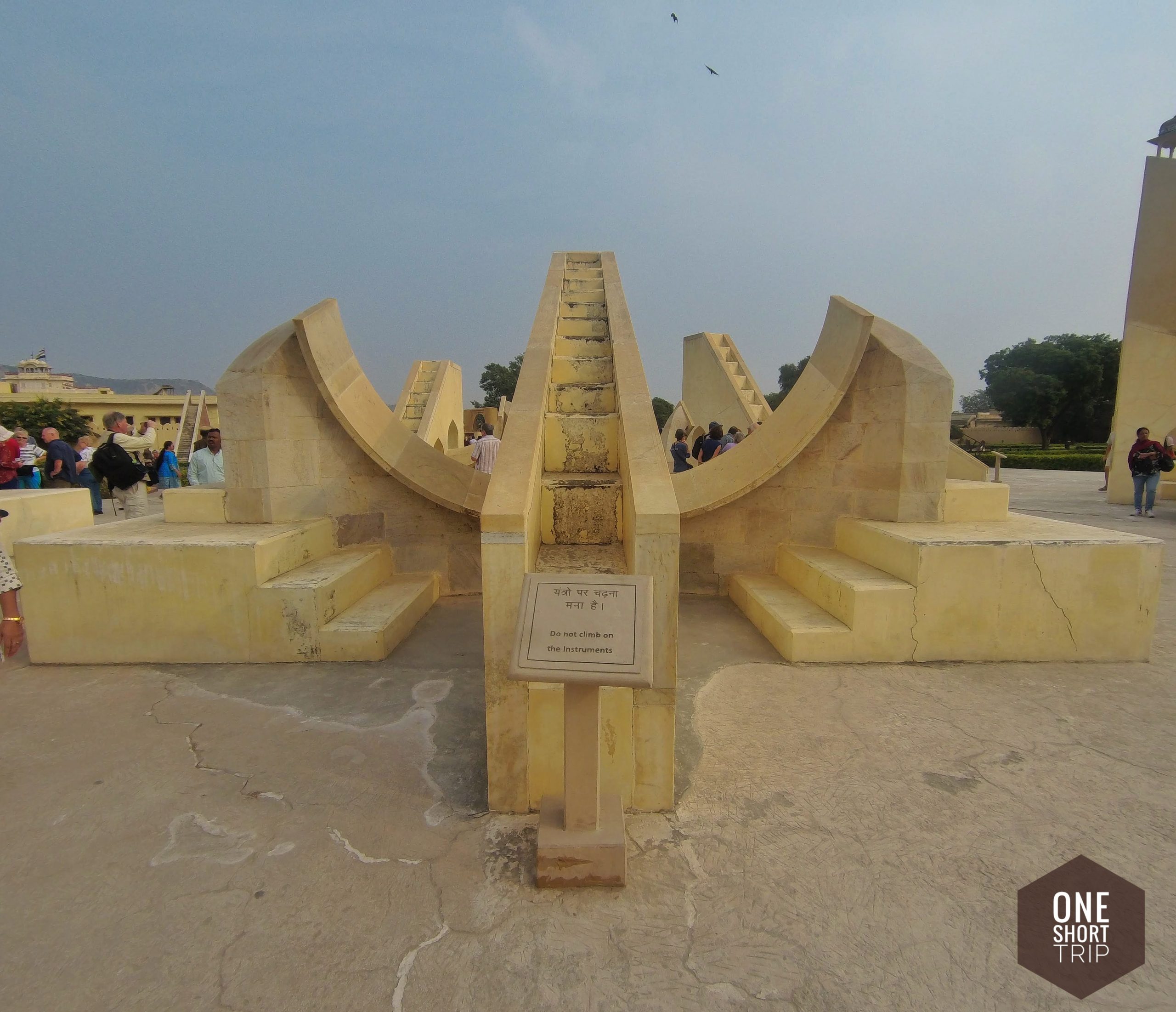
One of the most fascinating aspects of Jantar Mantar Jaipur is the way science was transformed into architecture. Instead of conventional buildings, the observatory is made up of enormous geometric forms—triangles, arcs, circles, pillars, ramps, bowls and walls—each positioned according to astronomical principles.
The structures were constructed primarily using local stone and marble, with carefully marked scales incorporated into the instruments. The monumental size was not simply intended to impress visitors. Large instruments made it possible to obtain readable measurements from their graduated surfaces and reduce certain observational difficulties associated with smaller instruments. Rajasthan Tourism describes the complex as covering approximately 18,700 square metres and containing 19 astronomical instruments.
UNESCO considers the observatory an outstanding example of monumental astronomical instruments and notes that some of its structures are among the largest ever built in their respective categories.
The Major Astronomical Instruments at Jantar Mantar Jaipur
The 19 instruments at Jantar Mantar were created for different types of astronomical observation. Some measure time, while others help determine the position, altitude, azimuth or celestial coordinates of the Sun and other heavenly bodies. Understanding these instruments is the key to appreciating why the monument is considered one of India's greatest historic observatories.
1. Brihat Samrat Yantra – The Giant Sundial
Brihat Samrat Yantra, also known as the Vrihat Samrat Yantra, is the most famous instrument at Jantar Mantar. It is a gigantic equinoctial sundial whose massive triangular gnomon is aligned with the Earth's rotational axis. The movement of its shadow across the graduated scale allows local solar time to be determined.
The structure is about 27 metres long and is recognised by Rajasthan Tourism as the world's largest stone sundial. Its scale is one of the clearest examples of how Jai Singh II converted astronomical mathematics into monumental architecture.
2. Laghu Samrat Yantra – The Smaller Sundial
Laghu Samrat Yantra follows the same basic principle as the larger Samrat Yantra but is smaller in size. Its sloping ramp is aligned towards the North Pole, and the shadow cast by the structure moves across its graduated scale as the Sun travels across the sky. It demonstrates the same fundamental relationship between sunlight, geometry and time on a more compact scale.
3. Jai Prakash Yantra
Jai Prakash Yantra consists of large hemispherical structures marked with graduated scales. By observing the position of the Sun or another celestial body and interpreting its inverted shadow or image on the marked surface, observers could determine several astronomical coordinates.
The unusual bowl-like form makes Jai Prakash one of the most visually distinctive instruments in the observatory. It also helps visitors understand that Jantar Mantar was not based on one single method of measurement; different instruments provided different astronomical perspectives.


4. Ram Yantra
Ram Yantra consists of paired cylindrical structures open to the sky, with a central pillar in each. Graduated markings on the inner surfaces allow observers to determine the altitude and azimuth of the Sun and other celestial bodies.
The instrument is particularly interesting because visitors can physically stand inside the structure and see how its walls, central pillar and open sky work together as part of the measurement system. Rajasthan Tourism notes that this type of instrument is found at Jantar Mantar in Jaipur and at the observatory in New Delhi.
5. Chakra Yantra
Chakra Yantra is a ring-shaped astronomical instrument used to determine celestial coordinates and the hour angle of the Sun. Its design demonstrates how circular geometry could be adapted to represent the movement and position of celestial objects.
6. Digamsa
Digamsa is a pillar-like instrument positioned within concentric circular structures. It is associated with determining the direction and timing of sunrise and sunset. The instrument illustrates the importance of observing the Sun's changing position along the horizon.
7. Nadivalaya
Nadivalaya consists of two circular plates oriented towards the northern and southern hemispheres. The design reflects the relationship between the Earth's hemispheres and the apparent movement of the Sun across the sky.
8. Kranti Vritya
Kranti Vritya is an astronomical instrument associated with measuring the solar position or solar declination during the daytime. It is another example of how the observatory used specialised instruments for different components of celestial measurement.


Astronomy, Timekeeping and Traditional Knowledge
Jantar Mantar is important because it shows how astronomical knowledge was applied to real-world questions. The instruments were capable of helping observers determine local time and study the position of celestial bodies, while astronomy was also connected with calendars, cosmology and traditional astrological practices.
The observatory therefore represents more than an early scientific installation. UNESCO describes it as a place where astronomical observation, society and beliefs came together. Its significance lies partly in the way scientific knowledge was embedded into the cultural and political life of the royal capital.
Jantar Mantar Jaipur and UNESCO World Heritage Status
Jantar Mantar Jaipur was inscribed on the UNESCO World Heritage List in 2010 under criteria (iii) and (iv). UNESCO considers it the most significant, comprehensive and best-preserved historic observatory of its kind in India. The site demonstrates a sophisticated tradition of astronomical observation through monumental fixed instruments designed for naked-eye observation.
UNESCO also highlights Jantar Mantar as an exceptional example of the meeting of different scientific cultures. Its instruments belong to a wider astronomical tradition that developed across several civilisations, while the Jaipur observatory represents a distinctive Indian expression of that knowledge during the early 18th century.
The observatory was protected as a monument of national importance in 1968, and its historic structures have undergone restoration and maintenance over the years. Rajasthan Tourism records major restoration work during the British period and again in 2006.
Why Jantar Mantar Is One of Jaipur's Most Unique Heritage Sites
Many historic monuments are remembered for palaces, forts, paintings or temples. Jantar Mantar is different because its main purpose was the observation and calculation of astronomical phenomena. The monument turns abstract ideas from mathematics and astronomy into structures that can be seen, walked around and understood physically.
For travellers, the experience becomes much more meaningful when the instruments are viewed as working scientific concepts rather than simply as unusual stone architecture. The massive Samrat Yantra, curved surfaces of Jai Prakash Yantra, cylindrical Ram Yantra and other geometric structures demonstrate how carefully the builders translated celestial relationships into physical form.
Today, Jantar Mantar stands as one of Jaipur's most important heritage attractions and as a rare surviving example of monumental astronomical architecture. Its combination of science, history, mathematics, architecture and cultural heritage makes it particularly valuable for travellers interested in understanding a different side of Jaipur beyond its famous palaces and forts.
Jantar Mantar Jaipur – Timings, Entry Fee, How to Reach, Best Time & Visitor Guide
Jantar Mantar Jaipur is one of the city's most distinctive heritage attractions and an important stop for travellers interested in astronomy, science, architecture and Rajasthan's royal history. Unlike a conventional palace or fort, the experience here comes from understanding how the monumental instruments were designed to observe the sky, measure time and determine celestial positions.
A visit is most rewarding when you allow enough time to understand the purpose of the different instruments rather than simply walking through the complex. Rajasthan Tourism currently lists guided tours and audio guides among the ways visitors can learn more about the observatory.


Jantar Mantar Jaipur Timings
According to the current Rajasthan Tourism listing, Jantar Mantar Jaipur is open from 9:00 AM to 7:00 PM. The last ticket is issued at 6:30 PM. These timings should be checked again before travelling because monument operating hours can occasionally change for special events, maintenance or administrative reasons.
Opening Time
9:00 AM
Closing Time
7:00 PM
Last Ticket
6:30 PM
Open Days
Check the official listing before your visit
Jantar Mantar Jaipur Entry Fee
The current Rajasthan Tourism entry fee is ₹50 for Indian visitors and ₹200 for foreign visitors. Tickets can be purchased at the monument entrance or online.
Tip: If you are planning a Jaipur sightseeing day, keep the current monument ticket information in mind when calculating your overall sightseeing budget. Entry charges for other attractions are separate.


How to Reach Jantar Mantar Jaipur
By Auto-Rickshaw
Auto-rickshaws are a convenient option for reaching Jantar Mantar from different parts of Jaipur. They can be particularly useful for travellers staying within or around the historic city area.
By Taxi or Cab
A taxi or app-based cab is a comfortable option for families, senior citizens and travellers covering several Jaipur attractions in a single day. Rajasthan Tourism specifically lists taxis as one of the ways to reach Jantar Mantar.
By Local Bus
Local buses can also be used to reach the central Jaipur area. Rajasthan Tourism lists local buses, taxis and auto-rickshaws as the main local transport options for reaching the monument.
By Private Vehicle
Travellers using a private car should remember that Jantar Mantar is located in the historic central Jaipur area. Traffic and parking conditions around the old city can affect travel time, so it is sensible to allow some extra time rather than planning a very tight sightseeing schedule.
Where Is Jantar Mantar Located?
Jantar Mantar is located in the central historic area of Jaipur, Rajasthan, next to the City Palace complex. Its location makes it particularly convenient to combine with other major attractions in the Pink City. Rajasthan Tourism also places Jantar Mantar among Jaipur's principal heritage attractions.
Because several important Jaipur attractions are concentrated in this part of the city, Jantar Mantar can be included naturally in a heritage sightseeing circuit rather than treated as a separate long-distance excursion.
Best Time to Visit Jantar Mantar Jaipur
The most comfortable time to explore Jantar Mantar is generally during the cooler months from October to March. Jaipur's winter and early spring weather makes walking through the open-air observatory more pleasant than the hotter months.
If you visit during summer, consider going closer to the opening time or later in the afternoon. Much of Jantar Mantar is an open-air complex, so direct sunlight and high temperatures can make extended exploration uncomfortable during the hottest part of the day.
What Is the Best Time of Day to Visit?
Morning is a particularly good choice for travellers visiting Jaipur in warmer weather because temperatures are generally more comfortable and the open-air nature of the observatory is easier to handle.
Late afternoon can also be pleasant, particularly during the cooler season. However, do not leave your visit too late because the last ticket is currently issued at 6:30 PM and the monument closes at 7:00 PM.


How Much Time Do You Need at Jantar Mantar?
Allow around 1 to 1.5 hours for a comfortable visit if you want to see the major instruments and understand their basic purpose. Visitors with a strong interest in astronomy, architecture or history may want to spend longer.
A guided tour or audio guide can make the visit considerably more informative because the geometric structures are easier to appreciate once you understand what each one was designed to measure. Rajasthan Tourism confirms that guides and audio guides are available as visitor-learning options.
Should You Hire a Guide at Jantar Mantar?
A guide can be worthwhile, especially for first-time visitors. Without an explanation, many of the structures may simply look like large geometric stone monuments. A knowledgeable guide can explain how the instruments relate to the Sun, time, celestial coordinates and traditional astronomical calculations.
Rajasthan Tourism also mentions audio guides, making them another option for visitors who prefer to explore independently.
What Should You Know Before Visiting?
- Jantar Mantar is primarily an open-air monument, so weather can strongly affect the comfort of your visit.
- The site is best understood when you know the basic purpose of instruments such as Samrat Yantra, Jai Prakash Yantra and Ram Yantra.
- Allow enough time rather than rushing through the complex as part of a packed Jaipur sightseeing schedule.
- Carry drinking water, particularly when visiting during warmer months.
- Comfortable footwear is useful because the visit involves walking around a large outdoor complex.
- During summer, sun protection such as a hat, sunglasses and sunscreen can make the visit more comfortable.
- Check the latest official timings and ticket information before travelling.
Jantar Mantar Jaipur for Families and Children
Jantar Mantar can be an interesting destination for families because it provides a visual introduction to astronomy, geometry and timekeeping. Children who are curious about science may particularly enjoy seeing how shadows, angles and carefully aligned structures were used to study the sky long before modern digital instruments.
For younger children, it helps to explain the instruments in simple terms rather than focusing heavily on technical terminology. Turning the visit into a practical lesson about the Sun, shadows and time can make the monument much more engaging.
Jantar Mantar Jaipur for Senior Citizens
Senior citizens who enjoy history, science and architecture can find Jantar Mantar highly rewarding. However, the site involves outdoor walking and exposure to the weather. Visiting during the cooler part of the day and allowing sufficient time for rest can make the experience more comfortable.
If mobility is a concern, it is advisable to check the current on-site accessibility arrangements directly before the visit rather than assuming that every instrument or pathway will be equally accessible.
Photography at Jantar Mantar Jaipur
Jantar Mantar's geometric structures make it one of Jaipur's most visually distinctive heritage sites. The enormous curves, ramps, scales, circular forms and shadows create strong architectural compositions for photography.
For ordinary tourist photography, always follow the current instructions displayed at the monument. Professional photography, commercial shoots or other specialised photography may be subject to separate permissions and charges, so these should not be assumed to be covered by a standard visitor ticket.
Nearby Places to Visit with Jantar Mantar
Jantar Mantar's central location makes it easy to combine with several of Jaipur's best-known heritage attractions. A practical sightseeing sequence can include the following:
- City Palace – directly associated with Jaipur's royal history and located beside Jantar Mantar.
- Hawa Mahal – one of Jaipur's most recognisable architectural landmarks.
- Johari Bazaar – a major shopping area known for jewellery and traditional goods.
- Tripolia Bazaar – a historic market area with traditional Jaipur shopping and local products.
- Albert Hall Museum – a major museum and heritage attraction elsewhere in central Jaipur.
For travellers concentrating on Jaipur's historic core, combining Jantar Mantar with City Palace and Hawa Mahal is particularly logical because these attractions are closely connected to the heritage landscape of the Pink City. Rajasthan Tourism identifies Jantar Mantar and Hawa Mahal among Jaipur's major attractions.
Suggested Jaipur Sightseeing Sequence
Option 1 – Historic Jaipur
City Palace → Jantar Mantar → Hawa Mahal → Jaipur bazaars
Option 2 – Full Jaipur Heritage Day
Amber Fort → City Palace → Jantar Mantar → Hawa Mahal → local markets
Is Jantar Mantar Jaipur Worth Visiting?
Yes, particularly if you want to experience a side of Jaipur that goes beyond forts and palaces. Jantar Mantar is unusual because its architecture was created around scientific measurement. The enormous instruments provide a direct connection between astronomy, mathematics, engineering and the history of Jaipur.
It is especially worthwhile for travellers interested in Jaipur's history, astronomy, architecture, mathematics, science, heritage and UNESCO World Heritage Sites. Even visitors who are not familiar with astronomy can appreciate the scale and ingenuity of the structures when they are properly explained.
Jantar Mantar Jaipur – Essential Visitor Summary
Jantar Mantar is one of Jaipur's rare monuments where the visitor can see scientific principles transformed into monumental architecture. With its UNESCO World Heritage status, historic astronomical instruments and central location, it deserves a place in a well-planned Jaipur sightseeing itinerary. Current timings and entry fees should be verified before travelling, as official visitor information can change.