

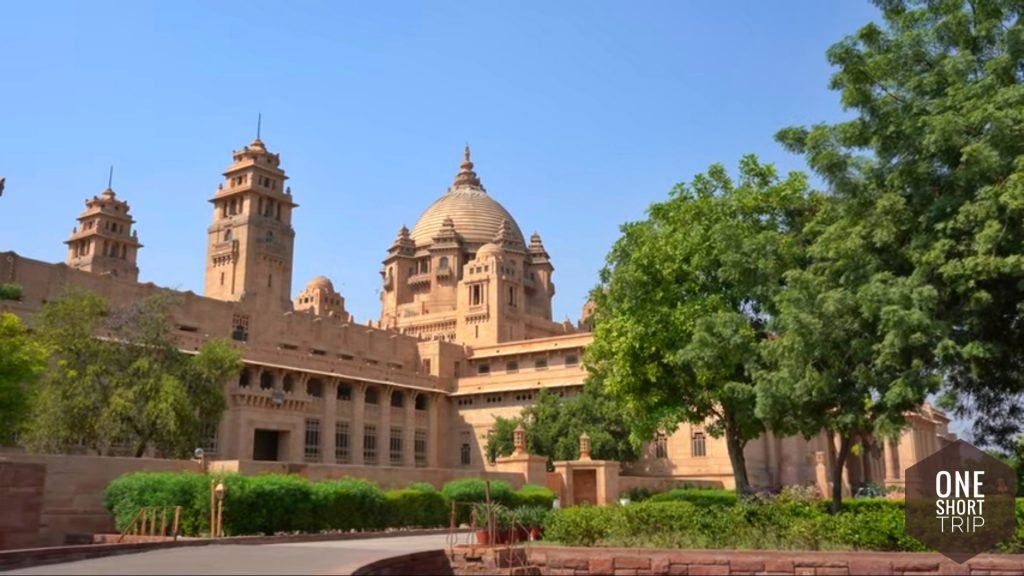
Umaid Bhawan Palace, Jodhpur – A Grand Royal Landmark of Rajasthan
Umaid Bhawan Palace is one of the most spectacular landmarks in Jodhpur and one of the last great royal palaces built in India. Rising above the Blue City, this enormous sandstone-and-marble complex combines the grandeur of a Maharaja's residence with the geometric elegance of early 20th-century architecture. Today, the palace has a unique identity: one part continues to serve as the residence of the Jodhpur royal family, another part operates as a luxury heritage hotel, and another section is open to visitors as the Umaid Bhawan Palace Museum.
Unlike the medieval forts and centuries-old palaces found across Rajasthan, Umaid Bhawan Palace belongs to a much more recent chapter of the state's history. Its construction began in 1929 under Maharaja Umaid Singh and was undertaken partly as a famine-relief project. The enormous building programme provided employment to thousands of local residents during a period of severe hardship, turning a royal construction project into an important piece of Jodhpur's social history. Rajasthan Tourism describes it as a palace built during the famine-relief effort, while government tourism sources note that construction took roughly 16 years and was completed in the 1940s. :contentReference[oaicite:1]{index=1}
History of Umaid Bhawan Palace
The story of Umaid Bhawan Palace begins with Maharaja Umaid Singh, the ruler of the princely state of Jodhpur. During the late 1920s, the region was facing a serious period of drought and famine. The Maharaja initiated the construction of a vast new palace not simply as a symbol of royal prestige but also as a way of generating employment for people affected by the crisis. Construction began in 1929 and continued for many years, eventually producing one of the most ambitious buildings of 20th-century Rajasthan. :contentReference[oaicite:2]{index=2}
The palace was constructed using locally sourced Chittar sandstone from the nearby Chittar Hill. Because of this connection with the stone and the hill from which much of the material was obtained, the building became associated with the name Chittar Palace during its construction. The warm golden-brown stone gives the palace its distinctive appearance, particularly when the walls catch the intense sunlight of Jodhpur. :contentReference[oaicite:3]{index=3}
The finished palace was intended to provide a modern royal residence while maintaining the ceremonial grandeur expected of a Maharaja's home. Its scale, engineering and decorative programme were remarkably ambitious for its time, and the building remains one of the most important examples of 20th-century palace architecture in Rajasthan.
Who Designed Umaid Bhawan Palace?
Umaid Bhawan Palace was designed by the renowned British architect Henry Vaughan Lanchester. The palace represents an unusual architectural experiment for Rajasthan because it does not follow a single traditional Rajput style. Instead, its design brings together Indian architectural influences with Western ideas that were popular during the early 20th century. :contentReference[oaicite:4]{index=4}
The architecture is commonly described as a combination of Indo-Saracenic, Classical Revival and Western Art Deco influences. This mixture is one of the reasons Umaid Bhawan Palace looks so different from older Rajasthan palaces such as Mehrangarh, City Palace Jaipur or Udaipur City Palace. Instead of relying primarily on centuries-old Rajput forms, the building reflects the cosmopolitan ambitions and changing architectural tastes of the princely states during the 1920s and 1930s. :contentReference[oaicite:5]{index=5}


Umaid Bhawan Palace Architecture
Architecture is one of the main reasons to visit Umaid Bhawan Palace. The enormous structure is built predominantly from golden Chittar sandstone along with marble and other carefully finished materials. Its monumental central dome, symmetrical composition, tall vertical elements and carefully planned courtyards give the palace an imposing presence while the decorative details reveal a much more refined Art Deco influence. :contentReference[oaicite:6]{index=6}
The central dome is among the palace's most recognisable features. Rising dramatically above the main building, it gives Umaid Bhawan a skyline that can be identified from a distance. Inside, the grand spaces, polished surfaces, geometric detailing and decorative elements reflect the architectural vocabulary of the period in which the palace was constructed.
The palace's design also incorporates Indian motifs and craftsmanship rather than completely abandoning local traditions. This combination of Indian decorative ideas, classical European planning and Art Deco geometry makes Umaid Bhawan particularly interesting for visitors who want to understand how royal architecture evolved during the final decades of princely India.
The Famous Palm Court
One of the palace's memorable interior spaces is the Palm Court, an airy and elegant area that reflects the grand scale of the building. Tourism accounts associate its concept with a conversation involving Maharaja Umaid Singh and architect H.V. Lanchester, with the Maharaja seeking a spacious and well-ventilated palace environment. The resulting interior spaces combine grandeur with a sense of openness and light. :contentReference[oaicite:7]{index=7}


What Is Inside Umaid Bhawan Palace?
The palace complex is divided into different functional areas, reflecting its unusual status as a building that continues to serve the royal family while also welcoming hotel guests and museum visitors. The public museum provides the easiest way for ordinary visitors to experience the palace's royal heritage without staying at the hotel.
The Umaid Bhawan Palace Museum presents objects connected with the Jodhpur royal family and the palace's history. Exhibits include royal artefacts, decorative objects, clocks, photographs, memorabilia and a collection of vintage cars. The museum helps visitors understand not only the architecture of the building but also the lifestyle, interests and ceremonial world associated with the former royal household. :contentReference[oaicite:8]{index=8}
The museum is therefore particularly useful for travellers who want more than an exterior photograph of the palace. While the monumental façade creates the first impression, the exhibits inside provide a closer look at the material culture of Jodhpur's royal family.
The Three Identities of Umaid Bhawan Palace
One of the most interesting things about Umaid Bhawan Palace is that it is not simply a museum. The complex continues to function in three distinct ways: as a royal residence, a luxury heritage hotel and a museum open to visitors. This unusual arrangement allows the palace to remain a living part of Jodhpur's royal heritage rather than existing solely as a preserved monument.
The hotel section is operated as a luxury heritage property associated with the Taj group, while the royal family continues to occupy a private section of the palace. Visitors should therefore understand that the entire palace is not open for unrestricted public exploration. The museum is the principal public-access area. :contentReference[oaicite:9]{index=9}


Umaid Bhawan Palace Museum
For most tourists, the museum is the main part of Umaid Bhawan Palace that can be explored independently. The collection provides a compact introduction to the history of the palace and the royal family, with displays of royal possessions, photographs, decorative pieces and vintage automobiles. It is an especially useful stop for visitors interested in the transition from traditional princely India to the modern era. :contentReference[oaicite:10]{index=10}
The vintage car collection is one of the museum's attractions, while the palace interiors and surrounding gardens provide additional opportunities for photography from the publicly accessible areas. Visitors should follow the museum's photography and access rules because parts of the palace remain private.
Umaid Bhawan Palace Gardens
The palace is surrounded by extensive landscaped grounds that soften the monumental sandstone architecture. The gardens are carefully maintained and form an important part of the palace experience, particularly when viewed against Jodhpur's otherwise dry landscape. The contrast between the green lawns, mature vegetation and golden stone creates some of the palace's most attractive views.
For photographers, the gardens also provide a different perspective from the conventional front-facing palace photograph. The combination of greenery, sandstone walls, domes and open sky can be especially striking during the softer morning and evening light.


