
Sri Chamarajeshwara Swamy Temple, Chamarajanagar
Sri Chamarajeshwara Swamy Temple is one of the most important religious and heritage landmarks in Chamarajanagar, Karnataka. Located in the heart of Chamarajanagar town, this historic Shiva temple is dedicated to Lord Chamarajeshwara and is known for its traditional architecture, spacious temple complex, sculptural details and strong association with the Wadiyar history of Mysuru.
The temple is particularly significant because the present structure was built during the reign of Mummadi Krishnaraja Wadiyar III in the 19th century. Karnataka Tourism records that the temple was constructed in 1826, while the Chamarajanagar District administration describes it as a prominent Dravidian-style temple and an important religious and historical site.


A Temple Connected with the Mysuru Wadiyars
The history of Chamarajeshwara Temple is closely connected with the Mysuru royal family. The present temple was commissioned by Mummadi Krishnaraja Wadiyar III in memory of his father, Chamaraja Wadiyar. Its construction forms part of the wider development of Chamarajanagar during the Wadiyar period.
The town itself was historically associated with the Mysuru kingdom and was later named Chamarajanagar after Chamaraja Wadiyar. This royal connection gives the temple an importance beyond its religious role, making it part of the cultural history of the region.


Lord Chamarajeshwara and the Temple Deities
The presiding deity is Lord Shiva, worshipped here as Chamarajeshwara. The temple is a living place of worship where devotees come for darshan, daily prayers and special religious occasions.
Karnataka Tourism records Goddess Kempananjamba to the left of Lord Chamarajeshwara and Goddess Chamundeshwari to the right. The temple complex also contains other shrines and sacred installations, making a visit more than a single-shrine darshan.
Dravidian Architectural Character
One of the defining features of Chamarajeshwara Temple is its traditional South Indian architectural character. The Chamarajanagar District administration identifies the temple as being built in the Dravidian style. Visitors can observe the prominent entrance tower, enclosed temple compound, mandapas, sculptural decoration and the carefully organised sacred spaces within the complex.
The temple's architecture is best appreciated slowly rather than only during a quick darshan. Look at the entrance, pillars, wall sculptures, mandapa details and the relationship between the outer courtyard and the inner sanctum. The combination of religious function and royal-era architecture gives the complex its distinctive character.
The Gopura and Temple Entrance
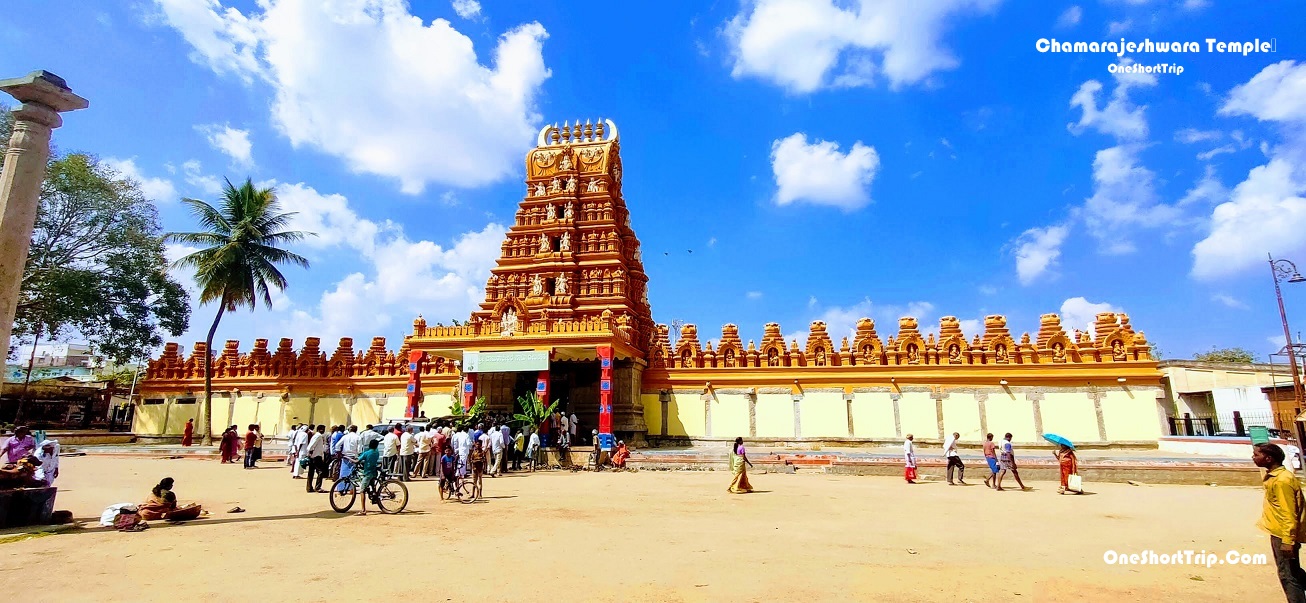
The temple entrance forms one of its most recognisable visual features. The gopura establishes the ceremonial approach to the shrine and introduces visitors to the enclosed sacred complex beyond it. The entrance area also provides an opportunity to appreciate the temple's sculptural vocabulary before entering the inner sections.
For travellers interested in Karnataka's temple heritage, Chamarajeshwara Temple is especially useful as an example of the religious architecture associated with the later Mysuru royal period.
Temple Paintings and Sculptural Details
The temple interior contains traditional decorative and artistic elements that add to its cultural value. Painted surfaces, religious imagery and sculptural details contribute to the visual character of the complex and reflect the role of temples as centres of art as well as worship.
The paintings and sculptures should be viewed as part of the larger temple environment rather than as isolated attractions. Visitors interested in architecture and art should allow enough time to look carefully at the interior spaces and details.
A Large and Spacious Temple Complex
Chamarajeshwara Temple is not simply a small neighbourhood shrine. Its spacious complex contains the principal Shiva shrine together with additional sacred spaces and supporting temple structures. The open courtyards and mandapas also provide space for religious gatherings and major festival activities.
Karnataka Tourism also notes the presence of a section associated with Sahasralingas—numerous Shiva Lingas—and other shrines dedicated to Hindu deities. These features add another layer to the religious importance of the temple complex.
A Living Centre of Worship
Although the temple has considerable historical and architectural value, it remains a functioning place of worship. Regular devotees visit for darshan and pooja, while larger crowds gather during important Hindu festivals and temple celebrations.
This combination of living religious tradition and royal-era heritage makes Chamarajeshwara Temple an important stop for travellers exploring Chamarajanagar's cultural attractions.
Exploring Chamarajeshwara Swamy Temple
The experience of visiting Chamarajeshwara Swamy Temple goes beyond a quick darshan. Once inside the complex, there are several details worth noticing, including the large Nandi, the sculptures arranged around the prakara, the old paintings, the different functional spaces of the temple and the shrines associated with the main deity.


The Five-Tier Gopura and Eastern Entrance
The principal entrance of Chamarajeshwara Temple faces east and is marked by a five-tiered gopura. The district's tourism information also records five ornamental kalashas at the top of the tower. In front of the temple is a Garuda pillar, creating a strong visual axis as visitors approach the main complex.
The entrance is therefore more than a gateway into the shrine. It establishes the ceremonial character of the temple and is one of the first architectural features visitors notice when arriving in Chamarajanagar.
The Large Nandi in the Temple Courtyard
After entering the temple, visitors encounter a large Nandi facing Lord Shiva. The presence of Nandi directly aligned with the Shiva shrine follows an important convention of Shaiva temple architecture and gives the central courtyard a strong devotional focus.
64 Ancient Sculptures in the Prakara
One of the less obvious features of the temple is the collection of 64 ancient sculptures of devotees arranged within the temple prakara. These figures add considerable interest for visitors who enjoy looking beyond the main shrine and studying the smaller artistic details of historic temples.
This is one reason it is worth allowing some time after darshan to walk through the complex. The outer areas provide a different perspective from the central sanctum and reveal how religious, artistic and community spaces were incorporated into the temple layout.
Yogashala, Pakashala and Other Temple Spaces
The temple complex also contains spaces connected with its religious and daily functioning. The district tourism record identifies a Yogashala in the north-eastern section and a Pakashala, or traditional kitchen, towards the south-east. Such spaces demonstrate that the temple was designed as a functioning religious institution rather than simply as a standalone shrine.
Historic Paintings Inside the Temple
The interior paintings are among the most interesting artistic elements of Chamarajeshwara Temple. The Chamarajanagar district tourism information identifies paintings depicting Girija Kalyana, Samudra Manthana and Chamundeshwari and describes them as around a century old.
These paintings are particularly valuable because they add a visual storytelling layer to the temple. Mythological episodes and divine figures were not merely decorative; such artwork formed an important part of how stories and devotional traditions were represented within temple spaces.

Religious Significance of the Temple
Chamarajeshwara Temple remains an active centre of Shiva worship in Chamarajanagar. Devotees visit for regular darshan, pooja and special religious occasions, while the temple becomes particularly active during major annual celebrations. The continued religious use of the complex is an important part of its heritage value.
Karnataka Tourism also records rows of Sahasralingas and additional shrines associated with the temple. These features make the complex relevant not only to visitors interested in architecture but also to those exploring Shaiva religious traditions in southern Karnataka.
Annual Ashada Rathotsava
The annual Rathotsava is the most important public celebration associated with Chamarajeshwara Temple. The district administration states that the grand chariot festival attracts thousands of devotees. The festival takes place in the month of Ashada, with the Rathotsava traditionally associated with Ashada Purnima.
For travellers interested in experiencing the temple during its most vibrant period, the Rathotsava provides an opportunity to see the temple functioning as a major community and religious centre. However, the same period also means significantly larger crowds than on an ordinary day.
Temple Timings
Published timings for Chamarajeshwara Temple vary between online listings. A commonly published schedule is approximately 5:30 AM to 12:00 PM and 6:30 PM to 9:30 PM. Other current listings show shorter evening hours, so visitors should confirm the day's darshan timings locally, particularly when travelling for a festival or special pooja.
Best Time of Day to Visit
Early morning is a good choice for devotees who prefer a quieter temple atmosphere, while the evening opening is convenient for travellers exploring Chamarajanagar during the day. If your main interest is the architecture and paintings, visiting when the temple is open but outside peak ritual periods can make it easier to appreciate the complex at a relaxed pace.
How Long Should You Spend Here?
Plan for approximately 45 minutes to 1 hour if you want to combine darshan with a proper look at the gopura, Nandi, prakara sculptures, paintings and other temple spaces. A shorter visit is possible if your priority is only darshan.
Getting to Chamarajanagar
Chamarajanagar is well connected by road with Mysuru and Bengaluru and is also served by rail. For a road trip from Bengaluru, the temple works particularly well as part of a southern Karnataka itinerary rather than as an isolated stop. Travellers coming from Mysuru can also combine the temple with several attractions towards Chamarajanagar and the B.R. Hills region.
Nearby Places to Combine with the Temple
Chamarajeshwara Temple can be combined with other heritage and religious attractions in Chamarajanagar district. For a heritage-focused route, consider Narasamangala's Ramalingeshwara Temple, Yelandur's Gowrishwara Temple and Triyambakeshwara Temple. The district administration currently lists these among its historic and religious attractions.
For a nature-and-temple itinerary, the temple can instead be combined with B.R. Hills, Biligiri Ranganathaswamy Temple, Himavad Gopalaswamy Betta or Bandipur, depending on the direction and time available. This makes Chamarajeshwara Temple a useful cultural stop before continuing towards the forest and hill regions of the district.
Tips for a Better Visit
- Visit early in the morning or during the evening opening if you prefer a calmer atmosphere.
- Dress modestly and follow the temple's instructions regarding footwear and restricted areas.
- Allow extra time if visiting during Rathotsava or another major festival.
- Look beyond the main shrine to see the Nandi, prakara sculptures, paintings and other temple spaces.
- Do not photograph restricted areas or rituals if temple authorities prohibit it.
- Confirm timings locally before making a dedicated trip, as published online schedules are not completely consistent.
Why Chamarajeshwara Temple Deserves a Place on Your Chamarajanagar Itinerary
Chamarajeshwara Swamy Temple brings together several layers of Chamarajanagar's identity: royal history, Shaiva worship, Dravidian temple architecture, historic paintings, sculpture and an active festival tradition. Its five-tiered entrance, large Nandi, 64 sculptures and old mythological paintings give visitors plenty to discover beyond the main darshan.
For travellers exploring southern Karnataka, it is therefore more than a quick temple stop. It provides a cultural introduction to Chamarajanagar before continuing towards the district's older temples, hill shrines, forests and wildlife destinations.