Kurudumale Ganesha Temple – A Sacred Hill Shrine Near Mulbagal
Kurudumale Ganesha Temple is one of the most remarkable Ganesha temples in Karnataka, known for its imposing monolithic idol, historic stone architecture and deep association with Hindu mythology. Located at Kurudumale near Mulbagal in Kolar district, the temple attracts devotees who seek the blessings of Lord Ganesha before beginning important phases of life, while history and architecture enthusiasts come to explore its ancient setting and distinctive craftsmanship.
Kurudumale is particularly notable because the village brings together two important historic shrines: the Mahaganapathy Temple and the nearby Someshwara Temple. The Karnataka government identifies Kurudumale as a place associated with Koundinya Giri and notes that the sacred traditions of the area are recorded in the Brahmanda Purana. The Ganesha shrine itself is distinguished by a huge stone image of Lord Ganesha and beautiful Vijayanagara-period architectural details.


The Sacred History of Kurudumale
Kurudumale has a history that extends beyond the present temple structure. The area is traditionally associated with Koundinya Giri, and the Kolar district government describes the place as an ancient sacred centre whose legend finds a place in the Brahmanda Purana. Kurudumale is also described as a former local centre of the Hoysala period, reflecting the long historical importance of this part of eastern Karnataka.
The history of the present Ganesha shrine is generally connected with the medieval period and the Vijayanagara tradition. Local and traditional accounts associate the construction of the temple with the Vijayanagara ruler Sri Krishnadevaraya, while the surrounding region also preserves evidence of earlier Chola and Hoysala influence. Rather than viewing the shrine as belonging to only one dynasty, Kurudumale is better understood as a sacred landscape that developed through several historical periods.
The temple's architectural character supports this layered history. The Karnataka government describes the Ganesha shrine as having beautiful carved pillars, an intricately worked doorway and a navaranga. The nearby Someshwara Temple, meanwhile, represents another important chapter in the heritage of Kurudumale and adds considerably to the historical importance of the village.
Why Kurudumale Ganesha Is Considered So Sacred
The spiritual importance of Kurudumale is closely connected with Lord Ganesha's role as Vighnaharta, the remover of obstacles. Devotees traditionally seek Ganesha's blessings before beginning a new undertaking, marriage, journey, business venture, education or another important stage of life. This tradition makes the temple especially meaningful for people who want to begin something new with a sense of auspiciousness.
The sacred traditions of Kurudumale are much older than the present stone structure. According to local and Puranic tradition, the site was visited and worshipped by divine beings and important figures from Hindu mythology. These stories form part of the religious identity of the place and should be understood as sacred traditions rather than archaeological evidence.
The Legend of the Trimurti and Kurudumale Ganesha
One of the best-known legends of Kurudumale says that Brahma, Vishnu and Shiva – the Hindu Trimurti – worshipped Lord Ganesha at this sacred location. According to the traditional story, the gods sought Ganesha's blessings before confronting the demon Tripurasura. After Ganesha helped remove the obstacle, the Trimurti is believed to have installed and worshipped the deity at Kurudumale.
Another traditional explanation connects the name of the place with the idea of a meeting or gathering hill. Variations of the name include Koodu Malai, Koodumale and Kurudumale. The sacred geography of the hill therefore becomes an important part of the site's identity, with mythology, landscape and worship closely intertwined.
Rama, Krishna and the Pandavas – Sacred Traditions of the Temple
Kurudumale is also associated with several stories from Hindu epics. Local tradition says that Lord Rama worshipped Ganesha here before proceeding with his journey and battle against Ravana. Another tradition connects the shrine with Lord Krishna, who is believed to have sought Ganesha's blessings during a difficult episode involving the Syamantaka jewel.
The Pandavas are similarly said to have visited the sacred site during their period of exile and offered prayers here before a major battle. These stories help explain why Kurudumale continues to be regarded by devotees as a place associated with auspicious beginnings and the removal of obstacles.
These epic associations belong to the religious and oral traditions surrounding Kurudumale. They are an important part of the temple's spiritual character, but they should not be confused with independently established historical dates.
The Magnificent Monolithic Ganesha Idol
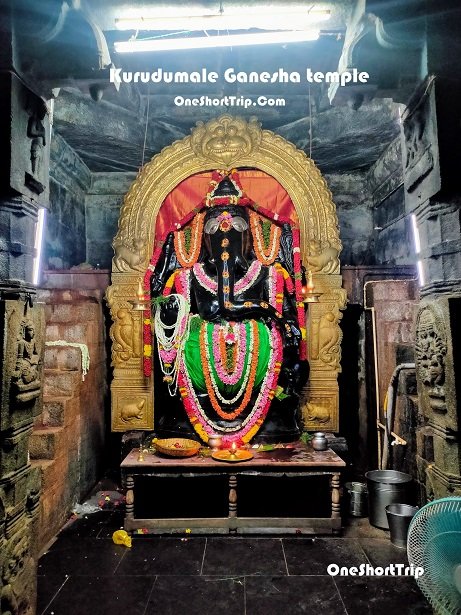
The main attraction of the temple is its enormous seated Ganesha idol carved from a single piece of dark stone. The Karnataka district government describes the image as approximately 13 feet high, while other published descriptions give slightly different measurements. Regardless of the exact measurement, the scale of the idol is what immediately distinguishes Kurudumale from many other Ganesha temples in Karnataka.
The massive form of the deity dominates the sanctum and creates a striking experience when viewed from the temple interior. The image is traditionally identified as a Saligrama stone Ganesha, and devotees regard the deity as particularly powerful. A popular belief also says that the idol continues to grow over time. This is a longstanding local belief and forms part of the temple's folklore.
In front of the main deity is the stone Mushika, the traditional vehicle of Lord Ganesha. The presence of the Mushika facing the sanctum creates an important visual connection between the devotee, Ganesha and his vahana.
Vijayanagara Architecture and Stone Craftsmanship
The Kurudumale Ganesha Temple is architecturally significant because its relatively restrained exterior gives way to carefully carved stone details within the temple complex. The shrine contains a garbhagriha, entrance and mandapa spaces, along with a navaranga supported by stone pillars.
The pillars and doorway display the craftsmanship associated with the medieval temple-building traditions of Karnataka. The temple is generally associated with the Vijayanagara period, while the wider Kurudumale landscape contains architectural elements representing earlier dynasties as well.
Popular tradition attributes portions of the temple's sculptural work to the celebrated master sculptor Jakanachari and his son Dankanachari. This attribution is part of local architectural tradition and should be treated as such rather than as a firmly established inscriptional fact.
The Navaranga, Pillars and Temple Details
The navaranga is one of the architectural spaces worth observing during a visit. Its stone pillars and carved surfaces reveal the importance given to structural decoration in Karnataka's medieval temples. The doorway is another notable feature, with detailed stone workmanship that contrasts with the enormous simplicity of the monolithic Ganesha inside.
For visitors interested in temple architecture, Kurudumale is therefore more than a place to see a large Ganesha idol. The proportions of the shrine, carved pillars, mandapa spaces and surrounding stonework offer a compact introduction to the architectural traditions that developed across the Kolar region.

Someshwara Temple – The Other Historic Shrine at Kurudumale
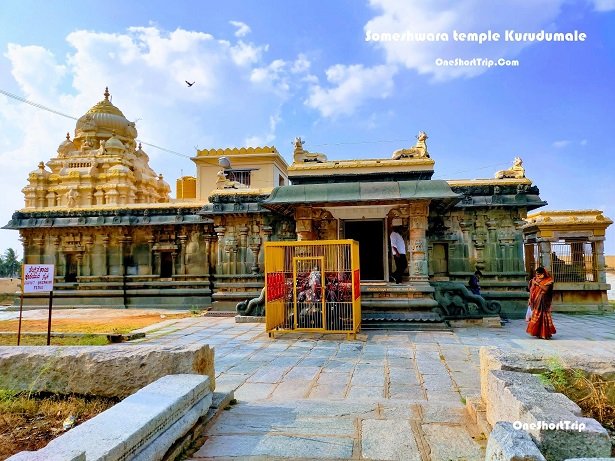
A visit to Kurudumale should not end with the Ganesha temple. Around the same sacred landscape is the historic Someshwara Temple dedicated to Lord Shiva. The Kolar district government describes this shrine as a Hoysala-period temple located close to the Ganesha temple, with a large stone base, a navaranga and numerous sculptural details.
The Someshwara Temple provides an interesting architectural contrast to the Ganesha shrine. Its stone construction, sculptural details and older historical associations make it an important companion attraction for anyone interested in the heritage of Kurudumale.
Together, the two temples show why Kurudumale is best understood as a heritage and pilgrimage destination rather than simply a single temple stop. The Ganesha shrine represents the powerful devotional identity of the village, while Someshwara adds another layer of architectural and historical interest.
History of Kurudumale Ganesha Temple
For a very long stretch of its existence, this Ganesha had no temple at all. The idol simply stood in the open, at the foot of the hill, weathering the seasons like any other rock formation nearby. What changed things, according to local accounts, was a series of quiet miracles noticed sometime in the Kali Yuga: rain that should have soaked the idol seemed to leave it dry, and the fierce Kolar sun that beat down on everything else in the area did not seem to touch it either. Villagers and wandering sages who witnessed this decided an idol capable of shrugging off rain and sun this way had to carry the blessing of the gods, and word of it eventually reached King Krishnadevaraya of the Vijayanagara empire.
Krishnadevaraya is said to have travelled to Kurudumale himself to see the idol, and after witnessing it, ordered that a proper homa and abhisheka be performed according to Shaivagama procedure. A temple was raised around the idol soon after, and inscriptions on its walls today are generally credited to his reign in the early sixteenth century, though some accounts suggest the Cholas had a hand in the site even earlier. Despite the royal patronage behind it, the temple that resulted is deliberately understated: there are no elaborately carved pillars, no towering gopura, no kalasha crowning the roof, and not even a dwajasthamba, the flagmast found at the entrance of most South Indian temples. The idol, not the architecture, was always meant to be the point.
Visiting Kurudumale Ganesha Temple – Timings, Travel and Practical Guide
Kurudumale Ganesha Temple is an easy pilgrimage stop for travellers exploring Mulbagal, Kolar and the eastern Karnataka region. The temple can be visited as a short standalone pilgrimage or combined with the historic Someshwara Temple and other attractions around Mulbagal. For most visitors, the temple itself does not require several hours, but allowing additional time makes the visit more relaxed, particularly when the surrounding heritage sites are included.
Kurudumale Ganesha Temple Timings
Morning Darshan
7:30 AM – 1:00 PM
Evening Darshan
3:30 PM – 7:30 PM
These timings are based on the current Sri Vinayaka Swamy Temple listing maintained by the Karnataka Hindu Religious Institutions and Charitable Endowments Department. The same official listing records morning and evening worship services, including abhisheka in the morning and the closing pooja in the evening. Temple schedules can change during festivals and special occasions, so devotees travelling specifically for a particular seva should confirm the schedule locally before planning around it.
Best Time to Visit Kurudumale Ganesha Temple
Early morning is generally the most comfortable time to visit Kurudumale Ganesha Temple. The weather is usually more pleasant, the surroundings are quieter and visitors have more time for darshan before the morning session ends. If you are travelling from Bengaluru, an early start also makes it possible to combine Kurudumale with other heritage and temple destinations around Mulbagal.
The months from July to October are often recommended for visiting the wider Kolar region because the landscape is greener and the weather can be more comfortable than the peak summer period. Ganesh Chaturthi is one of the most important occasions at the temple and attracts considerably larger crowds, so devotees looking for a quieter darshan should avoid the busiest festival periods.
How Long Do You Need at Kurudumale?
A focused visit to the Ganesha temple can usually be completed in around 30 to 60 minutes, depending on the crowd and time spent in prayer. Visitors interested in architecture should allow additional time to observe the stone pillars, entrance, mandapa and other details of the historic structure.
If you are also visiting the nearby Someshwara Temple, keeping around 1.5 to 2 hours for the two historic shrines makes the experience considerably more relaxed. Festival days and weekends can require extra time because of increased visitor numbers.


How to Reach Kurudumale Ganesha Temple
By Road from Bengaluru
Road travel is the most convenient way to reach Kurudumale from Bengaluru. The usual approach is towards Kolar and Mulbagal, followed by the local road to Kurudumale. The temple is located roughly 10–11 km from Mulbagal according to commonly published route information, making Mulbagal the most useful town for local transport and supplies.
From Mulbagal
Mulbagal is the nearest major town and an important transport point for visitors travelling to Kurudumale. From Mulbagal, visitors can continue by private vehicle, taxi or local transport towards Kurudumale. The short distance makes the temple particularly convenient to include in a Mulbagal temple circuit.
By Train
Visitors travelling by rail can use the railway connections serving the Mulbagal/Kolar region and continue to Kurudumale by road. Kolar is another useful railway access point, although the final journey to the temple requires road transport.
By Air
Kempegowda International Airport in Bengaluru is the nearest major airport for travellers arriving by air. From the airport, Kurudumale is best reached by road, either with a private vehicle or a pre-arranged taxi.
Parking and Local Facilities
Kurudumale is a village pilgrimage destination rather than a large urban tourist complex. Visitors travelling by car should follow the designated local parking arrangements and avoid blocking the temple approach road. On weekends and festival days, parking and the final approach can become busier than usual.
Basic food, refreshments and other everyday requirements are easier to find in Mulbagal than immediately around the shrine. Families travelling with children or senior citizens should therefore carry drinking water and any personal essentials they may need during the journey.
Entry Fee and Darshan
General temple entry is traditionally free. The Karnataka HRCE listing separately records charges for certain religious services such as archana, abhisheka, Sankashta Chaturthi and other sevas. These are optional services and should not be confused with a general entrance fee.
Devotees wishing to perform a specific seva should enquire at the temple counter about the day's availability, procedure and current charges, particularly during festival periods.
Festivals at Kurudumale Ganesha Temple
Ganesh Chaturthi is the most prominent festival associated with Kurudumale Ganesha Temple. The occasion brings increased devotional activity, special worship and large numbers of pilgrims. Traditional celebrations may include processions and special sevas, making the temple particularly vibrant during the festival period.
Sankashta Chaturthi is another important occasion for devotees of Ganesha. Since the temple is especially associated with worship before new beginnings and the removal of obstacles, special Ganesha worship on auspicious days can draw additional visitors.
If visiting specifically for a festival or seva, expect longer queues and a busier temple environment. Travellers who prefer a peaceful architectural and spiritual experience should consider an ordinary weekday morning instead.
Dress Code and Temple Etiquette
Kurudumale is an active Hindu place of worship, so visitors should dress modestly and respectfully. Comfortable traditional or conservative clothing is appropriate, particularly when entering the inner temple areas. Footwear should be removed before entering the designated temple areas.
Maintain silence or speak softly inside the shrine, follow the queue and instructions given by temple staff, and avoid touching sculptures, pillars or other historic elements. During rituals, devotees should allow priests and temple authorities to manage the movement of visitors around the sanctum.
Photography at the Temple
Photography rules can vary between the outer areas and active worship spaces. Visitors should follow the latest instructions displayed at the temple and avoid photographing restricted areas, priests during private rituals or devotees without permission. When in doubt, ask temple staff before taking photographs inside.
Is Kurudumale Suitable for Families and Senior Citizens?
Yes. Kurudumale can be a comfortable family pilgrimage destination because the main temple visit is relatively short and does not require a long trek. Senior citizens should nevertheless avoid rushing during crowded periods and allow extra time for footwear removal, queues and movement around the temple.
Families travelling with young children may find an early morning visit more comfortable, especially during warmer months. Festival days offer a lively cultural experience but can be considerably more crowded.
What to Carry for Your Visit
Useful Essentials
- Drinking water
- Comfortable and modest clothing
- Sun protection during daytime travel
- Personal medicines and essentials
- Small cash for offerings or temple services
For Families
- Water and light snacks for the journey
- Comfortable footwear that is easy to remove
- Sun protection for children and seniors
- Extra time during weekends and festivals
A Practical Way to Plan the Visit
For a peaceful pilgrimage, reach Kurudumale during the morning darshan session and complete the Ganesha temple visit before exploring the nearby Someshwara Temple. This gives enough time to appreciate both the religious significance and architectural heritage of the village without rushing.
Travellers making a larger Kolar or Mulbagal circuit can combine Kurudumale with other historic temples and attractions in the region. The destination works particularly well as a stop on a one-day heritage and temple road trip from Bengaluru.