
Tiruchendur Murugan Temple: Timings, History & How to Reach from Bangalore
Discover the second sacred abode of Lord Murugan on the Bay of Bengal coast, renowned for its Soorasamharam festival, ancient traditions and coastal temple architecture. Plan your pilgrimage from Bangalore with our complete travel guide.
Arupadai Veedu Tour Packages from Bangalore
Planning to visit the Arupadai Veedu temples from Bangalore? One Short Trip runs guided Arupadai Murugan temple tours. Choose the tour that suits your group.
A short two-day Arupadai Murugan temple trip from Bangalore.
View 2-Day Arupadai Tour →A guided pilgrimage to the Arupadai Veedu Murugan temples from Bangalore.
View Arupadai Temple Tour →Not sure which to pick? Send us your dates and group size on WhatsApp.
About Tiruchendur Murugan Temple, Tamil Nadu
Tiruchendur Subramaniya Swamy Temple, situated on the Bay of Bengal coast in Thoothukudi district, Tamil Nadu, is the second of the six Arupadai Veedu temples dedicated to Lord Murugan. The temple is approximately 600–650 km by road from Bangalore, depending on the route. Visitors should generally allow two to three hours for the temple and its immediate surroundings, with extra time for queues and the sacred Nazhi Kinaru.
Unlike the hilltop shrines of Palani, Thiruthani and Pazhamudircholai, Tiruchendur stands beside the sea. The temple is celebrated for Lord Murugan's victory over Surapadman, its ancient worship traditions, the imposing nine-tiered Rajagopuram and the annual Skanda Sashti festival.
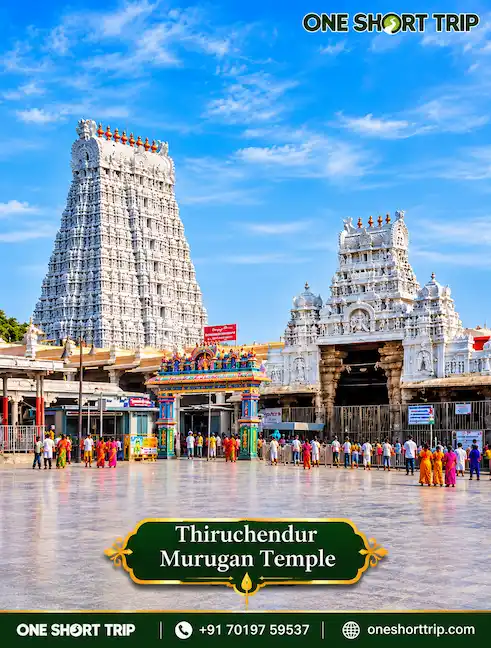
According to Hindu devotional tradition, Lord Murugan defeated the asura Surapadman at Tiruchendur. This victory is commemorated during Skanda Sashti, especially through the Soorasamharam ceremony, which attracts devotees from across India.
For pilgrims travelling from Bengaluru, Tiruchendur is an essential stop on the complete Arupadai Veedu Murugan temple circuit . Its location in southern Tamil Nadu makes advance planning particularly useful when combining multiple temples in one journey.
Tiruchendur Murugan Temple – Quick Information
Travel distances and visit durations are planning estimates. Confirm current temple opening hours and special-darshan arrangements before departure.
1. What Is Tiruchendur Murugan Temple Famous For?
Tiruchendur Murugan Temple is famous for its association with Lord Murugan's victory over Surapadman, its location beside the Bay of Bengal and its position as the second of the six Arupadai Veedu temples.
What Makes Tiruchendur Temple Special?
- It is the second sacred abode of Lord Murugan.
- It is traditionally associated with Murugan's victory over Surapadman.
- The annual Soorasamharam ceremony is one of its most significant religious events.
- The temple stands beside the Bay of Bengal, unlike the hilltop settings of several other abodes.
- Its nine-tiered Rajagopuram is an important architectural landmark.
- The nearby Nazhi Kinaru freshwater well is revered by devotees.
- Tiruchendur is celebrated in classical Tamil Murugan devotional traditions.
- It forms an important stop in the six-abode pilgrimage circuit.
For devotees, the temple represents the triumph of righteousness over evil. For travellers, Tiruchendur offers a combination of sacred history, traditional architecture and a memorable coastal landscape.
2. Where Is Tiruchendur Murugan Temple Located?
Tiruchendur Subramaniya Swamy Temple is situated in Tiruchendur town in Thoothukudi district, southern Tamil Nadu. The temple stands immediately beside the Bay of Bengal and is accessible by road and rail.
Arulmigu Subramaniya Swamy Temple,
Tiruchendur – 628215,
Thoothukudi District,
Tamil Nadu, India.
What Makes Its Location Unique?
Tiruchendur's proximity to the sea is one of its defining features. The temple complex, coastal promenade and Nazhi Kinaru are all associated with the same sacred landscape.
Travellers approaching from Bangalore commonly travel through major cities such as Salem and Madurai before continuing towards Tiruchendur. Other visitors may arrive via Tirunelveli or Thoothukudi.
Unlike Palani Murugan Temple , Thiruthani Murugan Temple and Pazhamudircholai Murugan Temple , Tiruchendur is not a hilltop pilgrimage destination.
3. What Is the Story of Tiruchendur Murugan Temple?
The principal legend of Tiruchendur describes Lord Murugan's battle against the powerful asura Surapadman. The story is central to the temple's religious significance and its annual Skanda Sashti celebrations.
Lord Murugan's Victory Over Surapadman
According to Hindu devotional tradition, Surapadman and his allies gained immense power and caused suffering among the devas. The devas sought divine protection from Lord Shiva.
Lord Murugan emerged as the commander of the celestial forces. Armed with the sacred Vel associated with Goddess Parvati, he led the battle against the asuras.
The battle culminated in Murugan's confrontation with Surapadman. According to the traditional account, Surapadman assumed several forms to escape defeat.
In the final encounter, Surapadman transformed into a mango tree. Lord Murugan split the tree with his Vel.
The two halves became a peacock and a rooster. Murugan accepted the peacock as his vehicle and the rooster as his emblem.
This narrative represents the defeat of arrogance and evil while also expressing divine compassion and transformation.
Why Is Tiruchendur Associated with Soorasamharam?
Tiruchendur is traditionally regarded as the sacred place where Murugan defeated Surapadman. During Skanda Sashti, the Soorasamharam ceremony commemorates this victory through a dramatic religious re-enactment.
What Is the Significance of Murugan's Vel?
The Vel is the divine spear of Lord Murugan. Devotees associate it with courage, wisdom, protection and the destruction of ignorance. It is a central symbol in Murugan worship.
What Is the Legend of Nazhi Kinaru?
Nazhi Kinaru is a sacred freshwater well near Tiruchendur Temple. Local devotional tradition associates the well with Lord Murugan providing freshwater for his forces after the battle against Surapadman.
Its location close to the sea makes it a distinctive part of the Tiruchendur pilgrimage experience.
4. What Is the History of Tiruchendur Murugan Temple?
Tiruchendur is an ancient centre of Murugan worship whose religious importance is reflected in classical Tamil literature and a long tradition of temple patronage.
The sacred site is traditionally associated with names such as Tiruchir Alaivai and Senthil. Its identity as a Murugan pilgrimage centre predates many of the later architectural additions visible in the present complex.
Tiruchendur in Classical Tamil Literature
Tiruchendur is associated with Tirumurukarruppatai, a classical Tamil devotional poem attributed to Nakkirar. The work celebrates Lord Murugan and the sacred places connected with his worship.
Development of the Temple Complex
The temple's architecture reflects different phases of construction, patronage and renovation. The sanctum, mandapams, corridors and monumental entrance tower are part of this evolving religious complex.
The Nine-Tiered Rajagopuram
Tiruchendur's nine-tiered Rajagopuram is one of the temple's most recognisable features. Its imposing appearance distinguishes the temple within the surrounding coastal town.
Historical Timeline of Tiruchendur Murugan Temple
Association with Lord Murugan's victory over Surapadman.
Tiruchendur becomes celebrated as a sacred destination in Murugan devotional literature.
Successive generations of rulers, patrons and devotees contribute to the temple's development and maintenance.
Expansion of temple structures and development of monumental features including the Rajagopuram.
Tiruchendur remains a major pilgrimage destination, especially during Skanda Sashti.
The temple's religious antiquity and the construction dates of its present buildings are separate historical questions. Exact dates should be attributed to specific structures only when supported by reliable historical or official records.
5. Who Built Tiruchendur Murugan Temple?
Tiruchendur Murugan Temple cannot be attributed in its entirety to one conclusively established historical founder. Its sacred origins belong to devotional tradition, while the present temple developed through successive periods of patronage and construction.
Was the Temple Established by Lord Murugan?
According to religious tradition, Tiruchendur is sacred because of Lord Murugan's victory over Surapadman. This is the temple's devotional origin narrative rather than a dated historical account of its construction.
Which Rulers Contributed to the Temple?
The temple's long history is connected with royal and community patronage in southern Tamil Nadu. Different structures and later additions reflect the continuing development of the sacred complex.
Tiruchendur's religious importance is rooted in ancient Murugan traditions. Its present architecture developed over time, rather than being constructed entirely by one ruler in a single period.
6. Who Is the Main Deity of Tiruchendur Murugan Temple?
The presiding deity of Tiruchendur Murugan Temple is Lord Subramaniya Swamy, also revered as Senthil Andavar. He is worshipped as the divine warrior who defeated Surapadman and protected the devas.
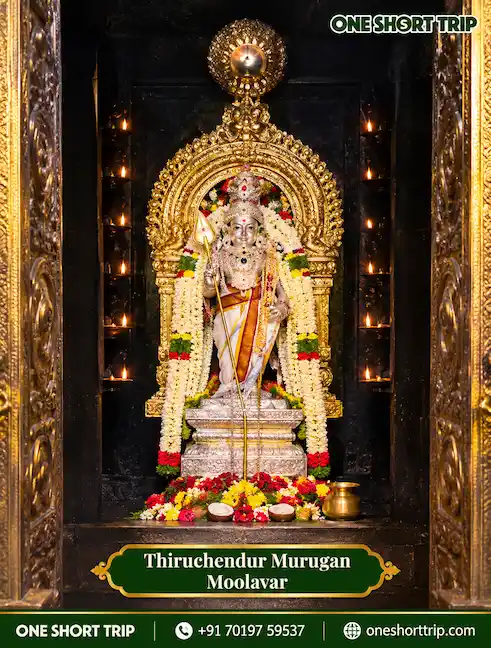
Why Is Lord Murugan Worshipped Here?
Tiruchendur is associated with Murugan's victorious and protective form. Devotees worship him as the deity of wisdom, courage, divine protection and spiritual grace.
What Do the Vel, Peacock and Rooster Represent?
The Vel represents divine wisdom and the power to overcome ignorance. The peacock is Lord Murugan's traditional vehicle, while the rooster appears as his emblem. Both are connected with the Surapadman legend.
What Do Devotees Pray for at Tiruchendur?
Devotees visit Tiruchendur to offer prayers, express gratitude and seek Lord Murugan's blessings for courage, well-being, protection and spiritual progress.
7. What Is the Religious and Spiritual Significance of Tiruchendur Murugan Temple?
Tiruchendur holds an important place in Tamil Hindu devotional traditions because of its connection with Murugan's victory over Surapadman, its status as the second Arupadai Veedu and its continuing traditions of worship.
Second Arupadai Veedu
Tiruchendur is one of the six sacred abodes traditionally visited by Murugan devotees.
Victory Over Surapadman
The temple symbolises the triumph of righteousness over arrogance and evil.
Sacred Coastal Setting
Its location beside the Bay of Bengal gives the temple a distinctive spiritual and geographical identity.
Devotion and Spiritual Renewal
Pilgrims visit for darshan, prayers, sacred rituals and participation in important Murugan festivals.
Why Is Skanda Sashti Important at Tiruchendur?
Skanda Sashti commemorates Lord Murugan's victory over Surapadman. At Tiruchendur, the festival is especially significant because the temple is traditionally associated with the battlefield of this divine encounter.
The Soorasamharam celebration is one of the most prominent religious events at Tiruchendur and attracts large numbers of devotees.
Why Is Nazhi Kinaru Considered Sacred?
Nazhi Kinaru is revered as a freshwater well near the sea. Its religious significance comes from local traditions connecting it with Lord Murugan and his victorious forces.
8. What Is the Connection Between Tiruchendur Temple and the Six Arupadai Veedu?
Tiruchendur is the second of the six Arupadai Veedu, the sacred abodes of Lord Murugan in Tamil Nadu. Each temple is traditionally associated with an important aspect of Murugan's divine life, teachings or worship.
What Are the Six Arupadai Veedu Murugan Temples?
Why Should Devotees Visit All Six Abodes?
Visiting the six Arupadai Veedu temples is an important devotional aspiration for many Murugan worshippers. Together, the temples celebrate different aspects of the deity's courage, wisdom, compassion and spiritual significance.
For travellers from Bangalore, the complete pilgrimage requires careful route planning because the six temples are spread across different parts of Tamil Nadu. Combining nearby destinations and allowing sufficient time for darshan makes the journey more manageable.
Plan Your Arupadai Veedu Murugan Pilgrimage
Explore all six sacred abodes of Lord Murugan, learn about their significance and plan a pilgrimage from Bangalore with the ONE SHORT TRIP guides.

9. How Far Are the Beach, Nazhi Kinaru and Railway Station from Tiruchendur Temple?
Once you reach Tiruchendur, most of the important attractions around the temple can be visited without a long road journey. However, the railway station, bus stand and parking areas are separate from the main temple entrance.
The seafront is immediately adjacent to the temple complex. Visitors can reach the coastal area on foot through the permitted access routes.
The sacred well is close to the temple's coastal area. Allow additional time for the approach, queues and any bathing arrangements.
The station serves Tiruchendur town. Arrange local transport if you have luggage, are travelling with children or prefer not to walk.
The bus stand connects the town with regional destinations. Auto-rickshaws and other local transport can be used to reach the temple.
Can You Walk from the Temple to Nazhi Kinaru?
Yes. Nazhi Kinaru is generally visited on foot from the temple-side coastal area. The walking time depends on the entrance used, the condition of the pathways and the crowd on the day.
Where Should You Park Your Vehicle?
Follow the designated parking arrangements around Tiruchendur. Do not assume that private vehicles can reach the temple's immediate entrance, particularly during festival periods or temporary traffic restrictions.
Travel tip: Use live navigation for the correct vehicle drop-off point rather than simply navigating to the centre of the temple complex. Walking access and vehicle access may be different.
10. What Are the Tiruchendur Murugan Temple Timings and Darshan Arrangements?
Tiruchendur Subramaniya Swamy Temple follows a daily schedule of worship, pujas and darshan. Visitors should distinguish between the general temple opening period, individual puja times, special-darshan arrangements and festival-day schedules.
Current official timings have not been independently verified for this guide. Rather than publish an uncertain schedule as confirmed information, visitors are advised to check the latest temple notice or official HR&CE information before travelling.
The timing information in this section is intended for visit planning and should not be treated as an official daily timetable.
How Should You Plan Your Darshan?
Check the current first-darshan and closing times, including any afternoon or evening schedule changes.
Certain rituals may affect movement through the darshan queue. Confirm the day's worship timetable.
Check the availability, eligibility, charges and designated counters for any special-darshan arrangements.
Weekends, holidays and auspicious occasions can increase waiting times. Avoid planning onward travel too tightly.
Are Special Darshan Tickets Available?
Special or paid darshan arrangements may be offered subject to current temple administration rules. Ticket categories, prices, booking methods and availability can change.
Purchase tickets only through authorised channels and confirm the applicable rules before entering a separate queue.
Where Can You Verify the Latest Temple Schedule?
Consult the Tamil Nadu Hindu Religious and Charitable Endowments Department and the temple's current official notices. For festival-day arrangements, local confirmation is especially important.
Verification status: As of 22 November 2026, this article does not claim to have verified an exact daily darshan or puja timetable. Confirm current hours before departure.
11. When Is the Best Time to Visit Tiruchendur Murugan Temple?
The most comfortable time to visit depends on your preference for quieter darshan, coastal weather or major religious celebrations. Tiruchendur is warm and humid for much of the year, so the time of day matters.
A good choice for visitors who want to complete darshan before the strongest daytime heat. Arrive according to the confirmed temple opening schedule.
Often more comfortable for spending time near the seafront after darshan. Check the evening worship schedule and local weather conditions.
Non-festival weekdays may offer a more manageable visit than major religious occasions, although crowd levels are never guaranteed.
Ideal for devotees who specifically want to participate in celebrations, but expect heavier crowds, longer queues and possible route restrictions.
Which Months Are Best for Tiruchendur?
These months are often more comfortable than peak summer for a coastal pilgrimage. However, the northeast monsoon can bring heavy rain and rough sea conditions, particularly during parts of this period.
What Should You Expect During Summer?
From roughly March to June, heat and humidity can make outdoor walking uncomfortable. Carry drinking water, avoid unnecessary exposure to the midday sun and arrange transport for elderly family members.
Is It Safe to Visit During Heavy Rain?
The temple town can experience intense rain, waterlogging and coastal weather warnings. During severe weather, follow local administration instructions, avoid the sea and reconsider non-essential outdoor activities.
12. What Are the Important Festivals Celebrated at Tiruchendur Murugan Temple?
Tiruchendur hosts several major Murugan festivals throughout the Tamil religious calendar. Each occasion brings different worship traditions, special rituals and visitor arrangements.
Usually observed in the Tamil month of Aippasi, Skanda Sashti is one of Tiruchendur's largest celebrations. Devotees observe fasting and prayers, and the Soorasamharam ceremony is a central highlight. The festival draws very large crowds.
Tiruchendur's Masi festival is associated with processions and ceremonial worship. Visitors should confirm the annual programme, as particular events may affect access and traffic.
Vaikasi Visakam is associated with Lord Murugan's divine manifestation. Devotees visit Murugan temples for prayers and special observances.
Thaipusam is a significant Murugan festival, associated with devotion to the Vel. Devotees may undertake vows, offerings and special worship.
The temple's Avani celebrations form part of its annual festival calendar and may include processions and ceremonial events.
Krittikai is an important recurring observance for Murugan devotees. Visitors may encounter additional worship activity on these days.
Should You Visit During Skanda Sashti?
Choose Skanda Sashti if participating in the festival is the main purpose of your journey. If your priority is a relaxed visit with family, a regular weekday may be more convenient.
Confirm the festival dates, procession schedule, permitted entry routes and accommodation availability well in advance. Tamil-calendar dates vary from year to year.
13. How to Reach Tiruchendur Murugan Temple from Bangalore, Chennai and Other Cities?
Tiruchendur is accessible by road and rail. The best option depends on your departure city, the number of people travelling and whether you are combining the visit with other destinations.
How to Reach Tiruchendur from Bangalore by Road?
A commonly used southern Tamil Nadu road approach is:
Bengaluru → Salem → Madurai → Tirunelveli → Tiruchendur
Depending on the chosen roads and stops, a journey of this length can take approximately 11–14 hours or longer. This is a planning estimate, not a guaranteed driving time.
For a family pilgrimage, consider overnight travel with suitable rest breaks or a multi-day itinerary. Driving immediately back to Bangalore after a full day of sightseeing can be exhausting.
How to Reach Tiruchendur from Chennai?
Travellers from Chennai can reach southern Tamil Nadu by road or train. A road journey may pass through major destinations such as Tiruchirappalli, Madurai and Tirunelveli, depending on the selected route.
For public transport, check trains serving Tiruchendur or suitable connecting stations before booking.
How to Reach Tiruchendur by Train?
Tiruchendur has its own railway station, making rail travel a practical option for some pilgrims. Depending on your starting city, you may need a connecting train or an onward road transfer.
Convenient for visitors who can find a suitable train connection to the town.
An important regional railway interchange from which travellers can continue towards Tiruchendur.
Check the current train timetable, boarding station and connection availability through IRCTC before making travel arrangements.
How to Reach Tiruchendur by Bus?
Tiruchendur is connected with regional towns through bus services. Travellers may find connections from Tirunelveli, Thoothukudi and other destinations in southern Tamil Nadu.
Long-distance travellers should verify whether their selected service terminates at Tiruchendur or requires a change of bus.
Which Airport Is Convenient for Tiruchendur?
Thoothukudi Airport is a regional option for reaching the area, subject to available flight schedules. Madurai Airport may offer an alternative depending on the origin city and flight availability.
An onward road transfer is needed from either airport. Compare total travel time and transfer costs before choosing a flight.
If you intend to visit several Murugan temples during one journey, a planned multi-day road itinerary can reduce repeated transfers and make luggage handling easier.
14. How Much Time Should You Allow for Tiruchendur Temple Darshan and Nearby Attractions?
The time required depends mainly on queue length, the type of darshan selected and whether you intend to visit the well and coastal area. Use the following estimates to organise your day.
| Type of Visit | Suggested Time |
|---|---|
| Temple darshan on a relatively quiet day | 1–2 hours |
| Temple darshan with extra queue allowance | 2–3 hours |
| Darshan and Nazhi Kinaru | 3–4 hours |
| Temple, well, seafront and meal break | Half a day |
| Temple plus additional nearby attractions | Most of a day |
| Major festival visit | Keep the schedule flexible |
Important: These are suggested planning allowances, not official queue estimates. On major festival days, waiting times may be considerably longer.
How Much Extra Time Should Families Allow?
Families with young children, elderly visitors or people with limited mobility should include additional breaks for meals, rest and movement between the parking area and the temple.
15. What Should You Know Before Visiting Tiruchendur Murugan Temple?
A little preparation can make your pilgrimage more comfortable. These practical guidelines are particularly useful for visitors arriving after a long journey.
Dress respectfully: Wear modest clothing suitable for a traditional Hindu temple.
Remove footwear: Use the designated footwear arrangements before entering restricted temple areas.
Check photography rules: Do not assume that mobile photography or filming is permitted inside the temple.
Follow queue instructions: Use the correct darshan entrance and follow directions from temple staff.
Carry drinking water: The coastal climate can be hot and humid, especially during summer.
Protect valuables: Keep wallets, phones and travel documents secure in crowded areas.
Respect sea warnings: Avoid entering the water during rough-sea conditions or when local authorities restrict access.
Plan for festival crowds: Book accommodation and transport early if travelling during major celebrations.
Consider accessibility: Ask about current assistance arrangements for elderly visitors and people with mobility difficulties.
Keep the surroundings clean: Dispose of waste responsibly around the temple, beach and sacred well.
Can Visitors Take a Bath in the Sea?
Some pilgrims traditionally bathe near Tiruchendur before darshan. However, swimming or entering the sea should never be treated as automatically safe.
Follow current local restrictions, weather advisories and instructions from authorised personnel. Children should be closely supervised.
16. What Are the Best Places to Visit Near Tiruchendur Murugan Temple?
Tiruchendur can be combined with nearby coastal attractions and additional religious destinations in southern Tamil Nadu. Some are suitable for a short walk, while others require a separate road trip.
A sacred freshwater well close to the temple. Check the current visitor arrangements, queues and any applicable charges.
The coastal area provides views of the Bay of Bengal. It is suitable for a brief visit when weather and safety conditions permit.
Sri Vaikuntanatha Perumal Temple at Srivaikuntam is an important Vaishnava pilgrimage destination. It requires a road journey from Tiruchendur.
Nine revered Vishnu temples situated in the Thamirabarani region. Covering all nine requires dedicated travel time and route planning.
Known for its coastal scenery and Christian heritage, including the Holy Cross Church. Consider it as a separate excursion.
A port city that may be useful for transport, accommodation and additional sightseeing when travelling through the region.
Which Nearby Attractions Should You Prioritise?
If you have only a few hours, prioritise the temple's immediate surroundings. If you have a full day with a vehicle, consider adding one or two destinations outside Tiruchendur.
The Nava Tirupati temples are better treated as a dedicated pilgrimage circuit rather than a quick sightseeing stop.
Group attractions by geography rather than trying to visit every destination in one day. This reduces unnecessary driving and leaves more time for worship.
17. Can You Visit Tiruchendur Temple and Nearby Attractions on the Same Day?
Yes. A same-day visit is practical when you stay within Tiruchendur and choose only a few nearby stops. Longer excursions should be planned separately if temple darshan takes more time than expected.
Suggested Order for a Relaxed Visit
Reach the town, use designated parking or arrange your local transport drop-off.
Prioritise the main purpose of your pilgrimage and follow the day's worship and queue arrangements.
Continue to the sacred well if it is accessible and time permits.
Allow time to refresh, especially after a long road or rail journey.
Spend a little time near the coast if conditions are suitable, or depart for your next destination.
Can You Add Srivaikuntam on the Same Day?
It may be possible if you have a private vehicle, begin early and encounter manageable queues. Check the second temple's opening schedule before committing to the route.
Festival advisory: During Skanda Sashti and other major celebrations, treat Tiruchendur as the main destination rather than planning a tightly packed sightseeing day.
18. Suggested One-Day Tiruchendur Murugan Temple Itinerary
This sample itinerary is intended for visitors who are already staying in Tiruchendur or nearby. It is not a same-day round trip from Bangalore.
| Suggested Time | Activity |
|---|---|
| 6:00–7:00 AM | Breakfast and preparation, adjusted to the confirmed temple opening time. |
| 7:00–10:00 AM | Temple darshan and time for worship, depending on the actual queue. |
| 10:00–11:30 AM | Visit Nazhi Kinaru, subject to access and waiting time. |
| 11:30 AM–1:00 PM | Lunch and rest. |
| 1:00–4:00 PM | Free time, rest or an optional local excursion. |
| 4:00–5:30 PM | Visit the seafront if weather conditions and local access permit. |
| After 5:30 PM | Return to accommodation or continue to the next destination. |
This is an illustrative sightseeing schedule, not the temple's official ritual timetable. Change the order and duration according to actual darshan timings, weather, queues and local transport.
How Should You Plan Tiruchendur from Bangalore?
Because of the long distance, travellers from Bangalore should generally include Tiruchendur within a multi-day itinerary. An overnight stay or a carefully planned group tour provides more flexibility than attempting to drive to the temple and return on the same day.
If your goal is to complete all six Murugan abodes, consult the Arupadai Veedu pilgrimage guide to understand how Tiruchendur fits into the wider route.
Explore the Murugan Temple Tour from Bangalore
Planning to visit multiple Arupadai Veedu temples? Explore the ONE SHORT TRIP itinerary to learn about the pilgrimage route and available tour arrangements.
View Arupadai Veedu Tour PackageFrequently Asked Questions About Tiruchendur Murugan Temple
Find answers to common questions about Tiruchendur Subramaniya Swamy Temple, including its religious significance, Soorasamharam, darshan arrangements, sacred well, festivals and travel from Bangalore.
1. Where is Tiruchendur Murugan Temple located?
Tiruchendur Subramaniya Swamy Temple is located in Tiruchendur, Thoothukudi district, Tamil Nadu, India. The temple stands beside the Bay of Bengal and is one of the six sacred abodes of Lord Murugan.
2. Why is Tiruchendur Murugan Temple famous?
Tiruchendur is famous as the second Arupadai Veedu of Lord Murugan, its association with the defeat of Surapadman, the annual Skanda Sashti Soorasamharam celebration and its unusual location beside the sea.
3. Which God is worshipped at Tiruchendur Temple?
Lord Murugan is worshipped as Subramaniya Swamy, also called Senthil Andavar. He is revered as the divine son of Lord Shiva and Goddess Parvati.
4. Is Tiruchendur the second Arupadai Veedu?
Yes. Tiruchendur is traditionally recognised as the second of the six Arupadai Veedu temples dedicated to Lord Murugan. The six abodes represent important episodes and spiritual aspects of Murugan worship.
5. What is the story behind Tiruchendur Murugan Temple?
According to Hindu tradition, Lord Murugan fought the asura Surapadman and his forces. Tiruchendur is associated with Murugan's victory, which symbolises the triumph of divine wisdom and righteousness over evil.
6. What is Soorasamharam at Tiruchendur?
Soorasamharam is the ritual enactment of Lord Murugan's victory over Surapadman. It is the principal highlight of the Skanda Sashti festival at Tiruchendur and attracts large numbers of devotees.
7. Why is Tiruchendur Murugan Temple located near the sea?
Tiruchendur's coastal location is closely associated with the traditional account of Lord Murugan's battle against Surapadman. The temple is distinctive among the six abodes because it stands beside the sea rather than on a hill.
8. What are the Tiruchendur Murugan Temple timings?
The temple follows a daily schedule of darshan and worship, but the exact current opening, closing and puja timings have not been independently verified for this guide. Check official Tamil Nadu HR&CE information or current temple notices before travelling.
9. Is there an entry fee at Tiruchendur Murugan Temple?
General temple entry and special-darshan arrangements should be treated separately. Check the current official notices for any applicable charges, ticket categories and booking procedures before your visit.
10. Is special darshan available at Tiruchendur Temple?
Special-darshan arrangements may be available under current temple rules. Availability, charges and entry procedures can change, so visitors should confirm the latest arrangements through authorised channels.
11. What is Nazhi Kinaru at Tiruchendur?
Nazhi Kinaru is a sacred freshwater well situated near Tiruchendur Temple and the seashore. It is an important pilgrimage attraction associated with the temple's traditional religious practices.
12. Can devotees bathe at Nazhi Kinaru?
Nazhi Kinaru is traditionally associated with ritual bathing. Current access, bathing arrangements, queue procedures and charges should be confirmed locally before planning to use the facility.
13. Can visitors take a bath in the sea near Tiruchendur Temple?
Sea bathing is a traditional practice for some pilgrims, but visitors must follow local safety instructions and weather advisories. Avoid entering the sea during rough conditions or when authorities restrict access.
14. What is the best time to visit Tiruchendur Murugan Temple?
November to February is generally more comfortable than peak summer for coastal sightseeing, although monsoon rain can affect travel. Early morning visits are often preferable for avoiding intense daytime heat.
15. When is Skanda Sashti celebrated at Tiruchendur?
Skanda Sashti is generally celebrated during the Tamil month of Aippasi, usually falling in October or November. The exact dates vary each year according to the Tamil calendar and the temple's festival schedule.
16. How far is Tiruchendur Murugan Temple from Bangalore?
Tiruchendur is approximately 650–700 kilometres from Bengaluru by road, depending on the route and starting point. Check live navigation for an accurate distance and driving-time estimate.
17. How can I reach Tiruchendur Temple from Bangalore?
You can travel by road through southern Tamil Nadu or use suitable train connections to Tiruchendur or Tirunelveli. A multi-day pilgrimage is generally more practical than attempting a same-day road return from Bangalore.
18. Which is the nearest railway station to Tiruchendur Murugan Temple?
Tiruchendur Railway Station serves the temple town. Tirunelveli Junction is another important railway connection for travellers who need to continue to Tiruchendur by regional transport.
19. Which is the nearest airport to Tiruchendur Temple?
Thoothukudi Airport is a regional airport option for Tiruchendur. Travellers can also compare flights to Madurai Airport, followed by a road transfer, depending on flight availability.
20. How much time is required to visit Tiruchendur Murugan Temple?
Allow approximately one to three hours for darshan on an ordinary day as a flexible planning estimate. If you are visiting Nazhi Kinaru and the seafront, setting aside half a day is more comfortable. Festival queues may take substantially longer.
21. Can senior citizens visit Tiruchendur Murugan Temple?
Yes. Senior citizens can visit the temple, but families should allow extra time for walking, queues and rest. Check current accessibility assistance and special arrangements with the temple administration before travelling.
22. Is photography allowed inside Tiruchendur Murugan Temple?
Photography and mobile-phone restrictions may differ between the outer premises and inner worship areas. Follow the temple's current notices and instructions rather than assuming photography is permitted.
23. Which places can I visit near Tiruchendur Temple?
Nearby attractions include Nazhi Kinaru, Tiruchendur's seafront, Manapad, Srivaikuntam and the Nava Tirupati temples. Some require a separate road journey, so plan according to your available time.
24. Can I visit all six Arupadai Veedu Murugan temples in one trip?
Yes. All six temples can be covered through a carefully planned multi-day pilgrimage across Tamil Nadu. Because the temples are spread across different districts, allow sufficient time for road travel, darshan, meals and rest. Read our complete Arupadai Veedu guide to explore the six destinations.
Plan Your Tiruchendur Murugan Temple Visit with One Short Trip
A pilgrimage to Tiruchendur offers devotees an opportunity to worship Lord Subramaniya Swamy at one of the most sacred Murugan temples in Tamil Nadu. Its coastal surroundings, traditional rituals and religious heritage make it an important destination on the Arupadai Veedu pilgrimage route.
For travellers beginning in Bangalore, Tiruchendur is a long-distance destination that benefits from careful planning. Coordinating transport, accommodation and darshan time becomes especially important when the journey includes multiple temples.
At ONE SHORT TRIP, we organise temple tour packages from Bangalore, helping travellers explore important pilgrimage destinations through thoughtfully planned itineraries.
Whether you are planning a family pilgrimage, travelling with senior citizens or hoping to visit all six sacred abodes of Lord Murugan, explore our Arupadai Veedu tour itinerary and plan a journey that suits your travel needs.
Explore Arupadai Veedu Tour Package from Bangalore →Explore All Six Arupadai Veedu Murugan Temples
Discover the significance, history and practical travel information for each of Lord Murugan's six sacred abodes.
Where Is Tiruchendur Murugan Temple Located?
Arulmigu Subramaniya Swamy Temple, also known as Thiruchendur Murugan Temple, is situated in Tiruchendur town in Thoothukudi district, Tamil Nadu. The temple stands beside the Bay of Bengal and is the second of the six sacred Arupadai Veedu temples of Lord Murugan. Use the map below to locate the temple and plan your journey.
You May Also Like
Planning A Trip Here?
Get help planning your visit — call or WhatsApp us and we will help you book a tour.