
One Short Trip

Adi Annamalaiyar Temple, Tiruvannamalai, Tamil Nadu
Pilgrimage

Adi Annamalai Temple, Tiruvannamalai

An ancient Shiva temple on the western side of Arunachala Hill, visited by devotees along the sacred Girivalam path in Tiruvannamalai.

Primary Deity
Lord Shiva (Adi Annamalaiyar)
Location
Western Side of Arunachala Hill
Religious Significance
Ancient Shiva Temple
Girivalam Route
Along the Sacred 14 km Circuit
Explore the Sacred Heritage of Arunachala

About Adi Annamalai Temple, Tiruvannamalai

Located on the western side of the sacred Arunachala Hill in Tiruvannamalai, Tamil Nadu, Adi Annamalai Temple is an important ancient Shiva shrine associated with the spiritual origins of Arunachala. Also known as Adi Arunachaleswarar Temple, this temple holds a special place in the religious traditions of Tiruvannamalai.

While the magnificent Arunachaleswarar Temple in the centre of the town is the principal pilgrimage destination, Adi Annamalai Temple is another significant shrine that devotees visit during their spiritual journey around Arunachala.

According to the traditional account preserved in the Arunachala Puranam, Lord Brahma installed and worshipped a Shiva Lingam known as Adi Annamalai on the western side of the sacred hill. This tradition connects the temple with the famous legend of Lord Shiva appearing before Brahma and Vishnu as an infinite column of light.

The temple is also an important stop along the Girivalam route, the approximately 14-kilometre sacred path around Arunachala Hill. Pilgrims walking clockwise around the hill visit Adi Annamalai Temple as part of their spiritual journey.

Adi Annamalai Temple – Quick Information

Official Temple Name
Arulmigu Adhi Annamalaiyar Temple
Other Names
Adi Annamalai Temple, Adi Arunachaleswarar Temple
Location
Adi Annamalai, Girivalam Path
Town and District
Tiruvannamalai, Tamil Nadu
PIN Code
606604
Presiding Deity
Lord Shiva – Adi Annamalaiyar
Religious Tradition
Shaivism
Temple Association
Lord Brahma and the Arunachala tradition
Location Around Arunachala
Western side of the hill
Girivalam Connection
Important shrine on the western section
Full Girivalam Distance
Approximately 14 km
Temple Administration
Tamil Nadu Hindu Religious and Charitable Endowments Department

Best time to visit: Early morning or evening, subject to the temple's opening hours. Important occasions include Pournami, Karthigai Deepam, Maha Shivaratri and Pradosham.

What Is Adi Annamalai Temple Famous For?

Adi Annamalai Temple is famous for its traditional association with Lord Brahma, its ancient Shiva worship and its location along the sacred Girivalam route around Arunachala Hill.

The word Adi is commonly understood as first, original or ancient. The name Adi Annamalai is therefore associated with the traditional idea of an ancient shrine of Lord Shiva at Arunachala.

The Temple Is Particularly Known For

  • Its traditional connection with Lord Brahma's worship of Lord Shiva.
  • Its association with the legend of Lord Shiva appearing as an infinite column of light.
  • Its traditional historical connection with the Pandya king Vajrangada.
  • Its location on the western side of Arunachala Hill.
  • Its importance as a stop during Girivalam.
  • Its major reconstruction and renovation history.
  • Its connection with the spiritual heritage of Tiruvannamalai.

For devotees, visiting Adi Annamalai Temple is an opportunity to experience another important part of the sacred landscape surrounding Arunachala, beyond the main temple in the town.

Where Is Adi Annamalai Temple Located?

Adi Annamalai Temple is located at Adi Annamalai village along the Girivalam Path in Tiruvannamalai, Tamil Nadu.

It stands on the western side of Arunachala Hill, while the main Arunachaleswarar Temple is situated on the eastern side of the hill in the town centre.

Official Temple Address

Arulmigu Adhi Annamalaiyar Temple,
Kirivalapathai, Tiruvannamalai – 606604,
Tamil Nadu, India.

The temple can be reached directly by road from Tiruvannamalai. It can also be visited as part of the traditional clockwise Girivalam walk around Arunachala.

Its position makes it an important stop for pilgrims exploring the western side of the sacred hill.

What Is the Story of Adi Annamalai Temple?

The story of Adi Annamalai Temple is closely connected with the divine manifestation of Lord Shiva as an infinite column of light and the traditional worship of Arunachala by Lord Brahma.

The temple's origin is explained through traditional accounts associated with the Arunachala Puranam.

The Sacred Legend

The Story of Lord Shiva's Infinite Column of Light

According to Hindu tradition, a dispute once arose between Lord Brahma and Lord Vishnu over who was supreme.

To resolve their disagreement, Lord Shiva appeared before them as a magnificent column of fire that extended beyond their ability to see its beginning or end.

Lord Shiva challenged both deities to discover the limits of this infinite manifestation.

Lord Vishnu's search: Lord Vishnu assumed the form of a boar and travelled downwards to find the base of the column. Despite his efforts, he could not reach its end. He eventually accepted that Lord Shiva's manifestation was beyond measurement.

Lord Brahma's search: Lord Brahma assumed the form of a swan and travelled upwards to find its summit. During his journey, he encountered a Ketaki flower descending from above.

Unable to reach the top, Brahma is said to have claimed that he had found it, with the flower supporting his statement.

Lord Shiva revealed the truth and exposed Brahma's false claim. This story represents the infinite nature of the divine and the limitations of human understanding.

How Did Arunachala Hill Become Sacred?

According to the traditional account, Lord Shiva's infinite column of fire later manifested as Arunachala Hill.

The divine fire assumed the form of a mountain so that devotees could worship the Lord in a form accessible to them.

For devotees, Arunachala is not simply a geographical hill. It is worshipped as Lord Shiva himself. This belief forms the foundation of Tiruvannamalai's spiritual importance and the tradition of Girivalam.

Why Is Lord Brahma Associated with Adi Annamalai Temple?

The Arunachala Puranam preserves an account in which Lord Brahma describes installing and worshipping a Shiva Lingam known as Adi Annamalai.

A Sri Ramanasramam publication explains that, according to this traditional account, Brahma consecrated the Lingam on the western side of Arunachala.

This shrine is identified with Adi Annamalai Temple. The traditional association with Lord Brahma is the central explanation for the temple's name and its special place in the spiritual heritage of Arunachala.

What Is the Story of Brahma and Tilottama?

Another traditional story associated with the area describes an episode involving Brahma and the celestial woman Tilottama.

According to this account, Brahma became deluded and pursued Tilottama, who took different forms while trying to escape him. She eventually sought refuge at the feet of Lord Shiva at Arunachala.

Lord Shiva appeared in the form of a hunter and confronted Brahma, helping him overcome his delusion.

A shrine known as Vediyappan Kovil, situated south of Adi Annamalai Temple, is associated with this legend in the Sri Ramanasramam account. These traditional stories are part of the religious heritage of Arunachala and help explain the significance associated with the western side of the hill.
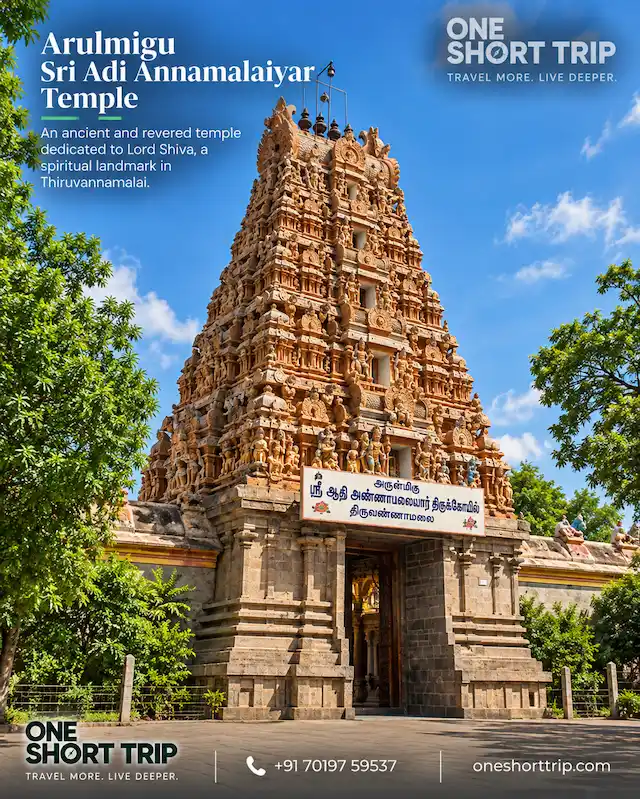
Adi Annamalaiyar Temple on the western side of Arunachala Hill in Tiruvannamalai
Adi Annamalaiyar Temple, Tiruvannamalai, Tamil Nadu

What Is the History of Adi Annamalai Temple?

Adi Annamalai Temple is traditionally regarded as one of the ancient Shiva shrines associated with Arunachala.

Its religious origins are preserved through the Arunachala Puranam, while its later structural history is associated with periods of reconstruction, renovation and consecration.

Although its traditional origin is ancient, a precise original construction year has not been established by the historical material consulted for this guide.

Ancient Origins of the Shrine

According to the traditional account, Lord Brahma installed and worshipped the Shiva Lingam at Adi Annamalai.

The name Adi means first or ancient, reflecting the shrine's traditional association with the early worship of Lord Shiva at Arunachala. The temple is also connected with the wider development of Tiruvannamalai as an important centre of Shaivism.

The Pandya King Vajrangada Connection

A historical account published in Sri Ramanasramam's Saranagathi magazine attributes the original temple structures, including the prakara walls and gopuram, to the legendary Pandya king Vajrangada.

According to this account, these structures had fallen into ruin before the major reconstruction completed in 1918.

Historical Clarification

This is an important traditional historical attribution associated with the temple. However, the available account does not establish a precise construction year or conclusively prove that Vajrangada built every part of the present structure.

The Major Reconstruction of 1918

One of the most important milestones in the temple's modern history was the extensive renovation that culminated in the Mahakumbhabhishekam of 1918.

The renovation was financed by a group of Chettiar devotees. The work was substantial and is described in the Sri Ramanasramam account as being almost a complete reconstruction because the earlier prakara walls and gopuram had fallen into ruin.

The 1967 Kumbhabhishekam

Following the 1918 consecration, another Kumbhabhishekam was performed in 1967. The historical account notes that this ceremony did not involve substantial restoration work because of a lack of funds.

Restoration Under Swami Ramanananda

A major restoration effort began again in 1993 with the assistance of devotees, particularly Swami Ramanananda.

The restoration programme involved approximately two years of work and culminated in the Mahakumbhabhishekam on 9 February 1996. This was a significant milestone in the modern history of Adi Annamalai Temple.

The 2012 Renovation and Consecration

Another renovation effort took place in 2011. The temple's Mahakumbhabhishekam was subsequently performed on 15 July 2012.

These restoration efforts helped preserve the shrine and maintain its importance as a place of worship along the Girivalam route.

Historical Timeline of Adi Annamalai Temple

TRADITIONAL ANTIQUITY
Origins of the Shrine

The shrine is associated with Brahma's traditional installation and worship of the Shiva Lingam.

PANDYA TRADITION
Earlier Temple Structures

The original temple structures are traditionally attributed to the legendary king Vajrangada.

1918
Major Reconstruction

Major reconstruction and Mahakumbhabhishekam, financed by Chettiar devotees.

1967
Kumbhabhishekam

Another consecration ceremony was performed.

1993 ONWARDS
Restoration Programme

A major restoration programme began with the assistance of devotees.

9 FEBRUARY 1996
Mahakumbhabhishekam

Consecration following the restoration work.

2011
Further Renovation

Another renovation effort took place.

15 JULY 2012
Mahakumbhabhishekam

Consecration following the renovation effort.

Who Built Adi Annamalai Temple?

This is one of the most frequently asked questions about Adi Annamalai Temple. The answer needs to distinguish the temple's traditional religious origin from the historical development of its physical structure.

Was Adi Annamalai Temple Established by Lord Brahma?

According to the Arunachala Puranam, Lord Brahma installed and worshipped the Shiva Lingam known as Adi Annamalai.

This is the traditional explanation of the shrine's religious origin. It is a religious account and should not be confused with a modern archaeological record identifying the architect or construction workers.

Which King Is Associated with Its Construction?

A Sri Ramanasramam historical account attributes the original prakara walls and gopuram to the legendary Pandya king Vajrangada.

This is the traditional royal attribution associated with the temple's earlier structures. However, the available material does not establish a precise construction year or provide conclusive inscriptional proof identifying Vajrangada as the historical builder of the complete temple.

Who Renovated Adi Annamalai Temple?

The temple's later restoration history is better documented:

  • A group of Chettiar devotees financed the major reconstruction completed in 1918.
  • Swami Ramanananda and other devotees supported the restoration programme that culminated in the 1996 Mahakumbhabhishekam.
  • A further renovation effort preceded the 2012 Mahakumbhabhishekam.
In Summary

Traditional accounts associate the establishment of the Shiva Lingam with Lord Brahma and the original temple structures with the legendary Pandya king Vajrangada. The major modern reconstruction was financed by Chettiar devotees, and later restoration work was supported by Swami Ramanananda and other devotees. The original historical builder of the complete present temple has not been conclusively identified.

Who Is the Main Deity of Adi Annamalai Temple?

The presiding deity of Adi Annamalai Temple is Lord Shiva, worshipped as Adi Annamalaiyar, also known as Adi Arunachaleswarar.

The Shiva Lingam is the central focus of worship. The temple's traditional identity is closely associated with Lord Brahma's worship of Shiva at Arunachala.

Devotees visit the shrine to offer prayers to Lord Adi Annamalaiyar and seek the blessings of Lord Shiva. The temple is part of the wider Shaivite pilgrimage landscape of Tiruvannamalai, where Arunachala Hill itself is also worshipped as a manifestation of Shiva.

What Is the Religious and Spiritual Significance of Adi Annamalai Temple?

Adi Annamalai Temple holds a special position in the religious traditions of Tiruvannamalai. Its significance comes from its connection with Lord Brahma, the infinite column of light and the sacred Arunachala Hill.

🛕

Connection with Lord Brahma

The temple is traditionally associated with Brahma's installation and worship of a Shiva Lingam. This gives the shrine an identity distinct from the main Arunachaleswarar Temple.

⛰️

Connection with Arunachala

Arunachala is revered as Lord Shiva in the form of a sacred mountain. Adi Annamalai Temple stands along the western side of this hill and forms part of the wider pilgrimage experience around it.

🙏

Importance During Girivalam

Pilgrims undertaking Girivalam visit several shrines around Arunachala. Adi Annamalai Temple is an important stop on the western side of the circuit.

🕉️

Prayer and Reflection

Many devotees visit the temple for darshan, prayer and spiritual reflection. Its setting away from the central town temple can make it a meaningful stop for those exploring the sacred heritage of Arunachala.

Beliefs about the spiritual benefits of worship are matters of faith and may vary among devotees.

What Is the Connection Between Adi Annamalai Temple and Girivalam?

Adi Annamalai Temple is located along the traditional Girivalam route around Arunachala Hill.

Girivalam, also known as Giri Pradakshina, is the sacred practice of walking around the hill in a clockwise direction. The complete circuit is approximately 14 kilometres, according to the Tiruvannamalai District Administration.

Devotees traditionally keep Arunachala Hill on their right throughout the walk. The route includes eight directional Lingams, several other shrines, sacred water bodies and spiritual institutions.

Where Does Adi Annamalai Temple Come on the Girivalam Route?

When pilgrims begin Girivalam near the eastern Rajagopuram of Arunachaleswarar Temple and walk clockwise, they first pass the eastern and southern sections of the route. They then continue around the western side of Arunachala.

Adi Annamalai village and its temple are located on this western stretch, after the Varuna Lingam section and before the Vayu Lingam section.

Route Information

The precise distance walked to reach Adi Annamalai Temple depends on the starting point and the route followed. The temple can also be reached directly by road without completing the entire Girivalam circuit.

Is Adi Annamalai One of the Ashta Lingams?

No. Adi Annamalai is a separate Shiva temple.

It is situated along the Girivalam route, but it is not counted among the eight directional Ashta Lingams.

The Ashta Lingams are eight distinct shrines associated with the eight directions around Arunachala Hill. Each has its own traditional name and directional association.

Adi Annamalai Temple is an additional important shrine along the same pilgrimage circuit. It should not be confused with Varuna Lingam or any of the other eight directional Lingams.

Should You Visit Adi Annamalai Temple During Girivalam?

Yes. If you are undertaking the complete Girivalam, you can include Adi Annamalai Temple in your pilgrimage.

You can stop for darshan, spend some time at the temple and then continue walking along the traditional route.

Visitors who do not wish to walk the entire circuit can also travel directly to the temple by road.

Continue Exploring

Explore More About Tiruvannamalai

Discover the principal Arunachaleswarar Temple, the eight Ashta Lingams and other important spiritual places around Arunachala with our detailed Tiruvannamalai travel guide.


How Far Is Adi Annamalai Temple from Arunachaleswarar Temple?

Adi Annamalai Temple is located on the western side of Arunachala Hill, while the main Arunachaleswarar Temple is located in Tiruvannamalai town. Since the two temples are on different sides of the hill, the distance depends on how you travel.

By Girivalam Route
Approx. 14 km

The complete clockwise Girivalam circuit around Arunachala Hill is approximately 14 kilometres. Adi Annamalai Temple is situated along its western section.

By Road
Direct Road Access

Visitors can travel directly from the main temple area using road navigation. The driving distance depends on the route selected and traffic restrictions.

Distance by Girivalam Route

The Tiruvannamalai District Administration describes the complete Girivalam circuit as approximately 14 kilometres. Adi Annamalai Temple is located on the western section of this circuit, after Varuna Lingam and before Vayu Lingam.

If you are walking from the main Arunachaleswarar Temple, you need to follow the traditional clockwise route around Arunachala rather than attempt to travel directly across the hill.

Distance by Road

Visitors travelling directly to Adi Annamalai Temple can use road navigation from the main temple area. The driving distance depends on the route selected and any traffic restrictions in place.

Travel Tip

Check live navigation before departure instead of relying on an approximate straight-line distance. During Pournami and major festival days, traffic restrictions may affect the road route.

What Are the Temple Timings of Adi Annamalai Temple?

Visitors should check the temple's current opening and closing timings before planning their visit.

The official Tamil Nadu Hindu Religious and Charitable Endowments Department website identifies Adi Annamalai Temple and provides its administrative listing. However, the online listing currently does not display a readable opening and closing schedule.

Important Timing Information

We are not publishing unverified morning and evening hours as confirmed temple timings. Please verify the current darshan schedule before travelling.

How Can You Confirm the Temple Timings?

Before travelling, follow these steps:

01
Check the HR&CE Listing

Refer to the official Tamil Nadu HR&CE temple listing for administrative information.

02
Confirm Locally

Check the current darshan schedule with the temple before setting out.

03
Check Festival Timings

Ask whether Pournami or festival days have a different schedule.

04
Allow Extra Time

Plan additional time if your visit is part of the Girivalam circuit.

Do not confuse the timings of the main Arunachaleswarar Temple with those of Adi Annamalai Temple. They are separate temples with separate schedules.

When Is the Best Time to Visit Adi Annamalai Temple?

The best time to visit Adi Annamalai Temple depends on whether you prefer a peaceful darshan, a festival atmosphere or a visit combined with Girivalam.

🌅

Early Morning

Early morning is a good choice for visitors who prefer a relatively peaceful temple atmosphere.

It is also more comfortable for people planning to walk around the hill or visit several temples in one day. Check the actual opening time before setting out.

🌇

Evening

An evening visit allows devotees to experience the temple during its later worship period.

It can be convenient for visitors combining Adi Annamalai with other destinations around Tiruvannamalai. Confirm the evening opening hours locally.

🌕

Pournami – Full Moon Day

Pournami is one of the most important occasions in Tiruvannamalai. Thousands of devotees visit the town to undertake Girivalam around Arunachala Hill.

Adi Annamalai Temple is an important stop along the western side of the route. Expect heavy crowds, traffic restrictions and longer waiting times.

🔥

Karthigai Deepam

Karthigai Deepam is the most significant annual festival associated with Tiruvannamalai. It celebrates Lord Shiva's manifestation as an infinite column of light.

The lighting of the sacred Deepam on Arunachala Hill is the major highlight. Arrange accommodation and transport well in advance.

Which Months Are Comfortable for Visiting?

November to February

The period from November to February is generally more comfortable for travelling and walking around Arunachala because of the comparatively cooler weather.

During Summer

Temperatures can become high during summer. Visitors undertaking Girivalam should avoid the hottest hours of the day and carry sufficient drinking water.

What Are the Important Festivals Associated with Adi Annamalai Temple?

Adi Annamalai Temple is connected with the wider religious calendar of Tiruvannamalai and the worship of Lord Shiva. Devotees visit during important festivals and sacred occasions throughout the year.

🔥

Karthigai Deepam

The major annual festival associated with Lord Shiva's manifestation as a column of light. The sacred Deepam lit on Arunachala Hill is the central highlight of the celebrations.

🌕

Pournami

Full-moon days attract large numbers of devotees who undertake Girivalam around Arunachala Hill. Adi Annamalai Temple is one of the important shrines along the route.

🕉️

Maha Shivaratri

An important festival dedicated to Lord Shiva, observed by devotees through prayers and worship.

🙏

Pradosham

A recurring sacred occasion associated with Lord Shiva worship, observed by devotees at Shiva temples.

🌺

Tamil Month Festivals

Devotees also visit during important days and celebrations in the Tamil calendar.

Festival planning: The exact temple-specific festival schedule should be confirmed locally. During major occasions, plan for increased crowds and possible traffic restrictions around Arunachala.

How to Reach Adi Annamalai Temple?

Adi Annamalai Temple can be reached by road from Tiruvannamalai town. Visitors travelling from other cities can first reach Tiruvannamalai and then continue towards Adi Annamalai village along the Girivalam Path.

From Tiruvannamalai Town

The temple is located on the western side of Arunachala Hill. Visitors can travel from the main temple area using:

🚗
Private Car
🚕
Taxi
🛺
Auto-Rickshaw
🚌
Local Transport

Local transport options depend on availability. If you are visiting only Adi Annamalai Temple, travelling by road is generally more convenient than walking the complete Girivalam circuit.

How to Reach Adi Annamalai Temple from Bangalore?

Travellers from Bangalore can reach Tiruvannamalai by road. You can plan a private car journey or include Adi Annamalai Temple as part of a longer Tiruvannamalai pilgrimage.

After reaching Tiruvannamalai, continue towards Adi Annamalai village along the Girivalam Path.

How to Reach Adi Annamalai Temple from Chennai?

Travellers from Chennai can reach Tiruvannamalai by road or suitable public transport connections.

After reaching Tiruvannamalai town, local road transport can be used to reach Adi Annamalai Temple.

How to Reach by Train?

Visitors can travel to Tiruvannamalai Railway Station and continue towards Adi Annamalai Temple by taxi or auto-rickshaw.

Check the latest train schedules before planning your journey.

How to Reach by Bus?

Tiruvannamalai is connected by bus services with several towns and cities in Tamil Nadu and neighbouring states.

From the Tiruvannamalai bus stand, visitors can hire local transport to reach Adi Annamalai Temple.

Travel Recommendation

If you are travelling with family or senior citizens and plan to visit multiple temples around Tiruvannamalai, arranging local transport in advance can make the visit more comfortable.

How Much Time Is Required to Visit Adi Annamalai Temple?

The time required to visit Adi Annamalai Temple depends on whether you are visiting only for darshan or combining the temple with other destinations around Tiruvannamalai.

Type of Visit Suggested Time
Short temple darshan 30–45 minutes
Relaxed temple visit 45–60 minutes
Temple visit with nearby stops Allow additional time
Visit during Pournami Allow extra time for crowds
Visit as part of Girivalam Include it within the full walking circuit

These are suggested planning estimates rather than official visit durations. If you are travelling with senior citizens or children, allow additional time for rest and movement.

What Should You Know Before Visiting Adi Annamalai Temple?

A little preparation can make your visit to Adi Annamalai Temple more comfortable. Keep these practical points in mind before travelling.

✓

Wear modest clothing: Choose clothing suitable for temple worship.

✓

Remove footwear: Remove footwear before entering designated temple areas.

✓

Follow temple instructions: Respect the instructions given by temple staff.

✓

Maintain a peaceful atmosphere: Help preserve the devotional environment of the temple.

✓

Check photography restrictions: Confirm whether photography is permitted before taking pictures.

✓

Carry drinking water: Essential if you are undertaking Girivalam, particularly during warmer weather.

✓

Avoid littering: Keep the temple surroundings and sacred Arunachala Hill clean.

✓

Confirm darshan timings: Check the day's temple opening hours before travelling.

✓

Plan for festival crowds: Expect increased crowds and traffic during Pournami and Karthigai Deepam.

✓

Consider accessibility: Senior citizens and visitors with mobility difficulties may find direct road access more comfortable than walking the entire Girivalam route.

What Are the Places to Visit Near Adi Annamalai Temple?

A visit to Adi Annamalai Temple can be combined with several important spiritual destinations around Tiruvannamalai. These places offer visitors a wider experience of the region's religious traditions, sacred landscape and spiritual heritage.

01 · Major Shiva Temple

Arunachaleswarar Temple

The main Arunachaleswarar Temple is one of the most important Shiva temples in Tamil Nadu. Dedicated to Lord Arunachaleswarar and Goddess Unnamulai Amman, it is the principal temple of Tiruvannamalai.

Read our detailed Arunachaleswarar Temple guide →

02 · Sacred Natural Landmark

Arunachala Hill

Arunachala is the sacred hill associated with Lord Shiva's manifestation as the infinite column of light. It is the centre of the Girivalam tradition and holds immense religious significance for devotees.

03 · Eight Directional Shrines

Ashta Lingams

The eight directional Lingams are important shrines situated around Arunachala. They form an important part of the traditional Girivalam pilgrimage.

04 · Spiritual Ashram

Sri Ramanasramam

Sri Ramanasramam is associated with the life and teachings of Bhagavan Sri Ramana Maharshi. It is an important spiritual destination for visitors interested in meditation, silence and self-enquiry.

05 · Spiritual Ashram

Seshadri Swamigal Ashram

This ashram is associated with Sri Seshadri Swamigal, a revered saint of Tiruvannamalai. It is another spiritual destination that visitors can consider including in their town visit.

06 · Arunachala Hill

Virupaksha Cave and Skandashram

Located on the slopes of Arunachala, these places are associated with the spiritual life of Ramana Maharshi.

Reaching these places involves walking uphill. Visitors should consider their fitness, available time and comfort before planning a visit.

If you plan to cover several of these destinations, allow enough time for travel, darshan and rest. The order of visits can be adjusted depending on your starting point and the day's traffic conditions.

Can You Visit Adi Annamalai Temple and Arunachaleswarar Temple on the Same Day?

Yes. You can plan to visit both Adi Annamalai Temple and the main Arunachaleswarar Temple on the same day, provided you allow enough time for darshan and travel between the destinations.

Suggested Order of Visits

1
Begin at Arunachaleswarar Temple

Start your day with darshan at the main Arunachaleswarar Temple.

2
Visit Selected Ashta Lingams

Visit selected directional Lingams around Arunachala, depending on your available time.

3
Travel Towards Adi Annamalai Temple

Continue towards the western side of Arunachala Hill.

4
Visit Adi Annamalai Temple

Spend time at the temple and offer prayers to Lord Adi Annamalaiyar.

5
Explore Other Spiritual Destinations

Visit Sri Ramanasramam or other nearby spiritual destinations if time permits.

Festival Day Advisory

During Pournami and Karthigai Deepam, traffic and crowds may affect travel time. Keep your schedule flexible and allow extra time between destinations.

Suggested One-Day Tiruvannamalai Temple Visit Plan

If you have one day in Tiruvannamalai and want to cover the major spiritual attractions, consider the following suggested sightseeing plan.

Time Suggested Activity
Early Morning Visit Arunachaleswarar Temple
Morning Visit selected Ashta Lingams
Late Morning Travel towards Adi Annamalai Temple
Afternoon Lunch and rest
Evening Visit Sri Ramanasramam or Seshadri Swamigal Ashram
Evening / Night Return to the main temple area or continue your journey
Important Planning Note

This is a suggested sightseeing plan, not a fixed temple schedule. Actual timings and the order of visits may need to change depending on darshan availability, travel conditions and the time spent at each destination.

If your main purpose is to complete Girivalam, plan a separate block of time for the full walking circuit. Avoid trying to combine the entire walk with a packed sightseeing itinerary.

Visitor Information

Frequently Asked Questions About Adi Annamalai Temple

Find answers to common questions about Adi Annamalai Temple, including its history, Brahma connection, Girivalam route, timings, travel options and nearby attractions.

1. Where is Adi Annamalai Temple located?

Adi Annamalai Temple is located at Adi Annamalai village along the Girivalam Path in Tiruvannamalai, Tamil Nadu – 606604.

2. What is Adi Annamalai Temple famous for?

The temple is famous for its traditional association with Lord Brahma, its ancient Shiva worship and its location along the western side of the Girivalam route around Arunachala Hill.

3. Who built Adi Annamalai Temple?

According to the traditional account, Lord Brahma installed and worshipped the Shiva Lingam at Adi Annamalai. The original temple structures are traditionally attributed to the legendary Pandya king Vajrangada, while the major reconstruction completed in 1918 was financed by Chettiar devotees.

4. Is Adi Annamalai Temple older than Arunachaleswarar Temple?

Adi Annamalai is traditionally regarded as an ancient shrine associated with the early worship of Lord Shiva at Arunachala. However, there is insufficient evidence to establish a precise construction date or definitively prove that the present structure is older than the main Arunachaleswarar Temple.

5. What is the story behind Adi Annamalai Temple?

According to the Arunachala Puranam, Lord Brahma installed and worshipped a Shiva Lingam called Adi Annamalai on the western side of Arunachala. This is the traditional origin story associated with the shrine.

6. Which God is worshipped at Adi Annamalai Temple?

The presiding deity is Lord Shiva, worshipped as Adi Annamalaiyar or Adi Arunachaleswarar.

7. What is the meaning of Adi Annamalai?

The word Adi means first, original or ancient. Adi Annamalai is traditionally associated with the ancient or original shrine of Lord Shiva at Arunachala.

8. What are the timings of Adi Annamalai Temple?

The official HR&CE online listing does not currently display confirmed opening and closing hours for Adi Annamalai Temple. Visitors should check the current darshan schedule locally before travelling.

9. Is Adi Annamalai Temple part of Girivalam?

Yes. The temple is located on the western side of the traditional Girivalam route around Arunachala Hill.

10. Is Adi Annamalai one of the eight Lingams?

No. Adi Annamalai is a separate Shiva temple on the Girivalam route. The Ashta Lingams are eight other shrines associated with the eight directions.

11. How far is Adi Annamalai Temple from Arunachaleswarar Temple?

Adi Annamalai Temple is on the western side of Arunachala Hill. The full Girivalam circuit is approximately 14 kilometres. The exact direct driving distance depends on the road route selected.

12. Can I reach Adi Annamalai Temple by car?

Yes. Visitors can travel directly to the temple by private car or taxi from Tiruvannamalai town.

13. Can senior citizens visit Adi Annamalai Temple?

Yes. Senior citizens can travel directly to the temple by road. This can be more comfortable than walking the entire Girivalam route.

14. Can I visit Adi Annamalai Temple during Pournami?

Yes. Many devotees visit the temple during Pournami as part of Girivalam. Expect larger crowds and increased traffic on full-moon days.

15. How much time should I spend at Adi Annamalai Temple?

For a short darshan, allow approximately 30–45 minutes. If you want a more relaxed visit, allow around one hour, depending on the crowd.

16. What is the connection between Adi Annamalai Temple and Lord Brahma?

The Arunachala Puranam account says that Brahma installed and worshipped a Shiva Lingam called Adi Annamalai on the western side of Arunachala. This is the traditional origin story associated with the shrine.

17. When was Adi Annamalai Temple renovated?

A major reconstruction financed by Chettiar devotees culminated in the 1918 Mahakumbhabhishekam. Further consecrations took place in 1967, 1996 and 2012.

18. Who was Swami Ramanananda and what was his connection with the temple?

Swami Ramanananda was a devotee associated with the restoration of Adi Annamalai Temple in the 1990s. The restoration programme culminated in the Mahakumbhabhishekam on 9 February 1996.

19. Which places can I visit near Adi Annamalai Temple?

You can combine your visit with Arunachaleswarar Temple, the eight Ashta Lingams, Sri Ramanasramam, Seshadri Swamigal Ashram, Virupaksha Cave and Skandashram.

20. Can I visit Adi Annamalai Temple and complete Girivalam on the same day?

Yes. The temple is located on the Girivalam route, so you can visit it during the walk. Plan sufficient time for the complete circuit, rest breaks and darshan.

21. Is there an entry fee at Adi Annamalai Temple?

We have not found a reliable current official source confirming a general entry fee or separate darshan charges. Check with the temple administration for current arrangements.

22. Is photography allowed inside Adi Annamalai Temple?

Photography rules may differ between the outer premises and the inner temple areas. Follow the notices and instructions provided by temple authorities.

23. Can I visit Adi Annamalai Temple without doing Girivalam?

Yes. You do not need to complete Girivalam to visit Adi Annamalai Temple. You can travel directly to the shrine by road from Tiruvannamalai.

24. What is the best time of year to visit Adi Annamalai Temple?

November to February is generally more comfortable for outdoor sightseeing and walking around Arunachala. Pournami and Karthigai Deepam are important religious occasions but are also much busier.

Explore Tiruvannamalai with One Short Trip

Plan Your Tiruvannamalai Temple Visit with One Short Trip

Tiruvannamalai is more than a destination for temple darshan. It is a sacred place where ancient traditions, spiritual heritage and the natural presence of Arunachala Hill come together.

From the magnificent Arunachaleswarar Temple to the ancient Adi Annamalai shrine and the eight directional Lingams around the hill, every destination offers an opportunity to understand the religious significance of this sacred town.

Whether you are planning a family temple visit, a pilgrimage with senior citizens or a complete Girivalam experience, a well-planned itinerary can make your journey more comfortable.

At One Short Trip, we help travellers plan temple tours from Bangalore and other destinations with practical travel arrangements and thoughtfully planned itineraries.

Explore More About Tiruvannamalai

Planning A Trip Here?

Get help planning your visit — call or WhatsApp us and we will help you book a tour.