

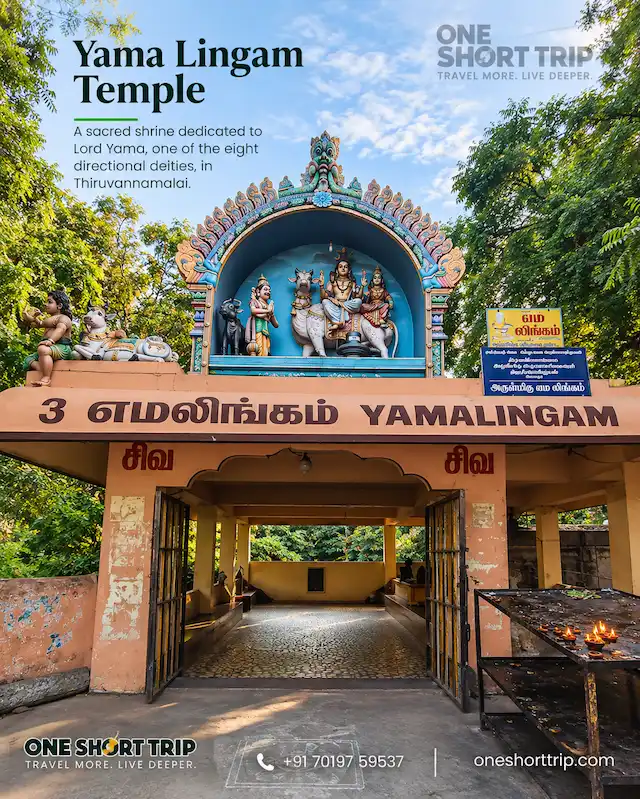
Yama Lingam Temple
Discover Yama Lingam, one of the eight sacred Ashta Lingams along the Girivalam path around Arunachala Hill in Tiruvannamalai.
Yama Lingam, Tiruvannamalai – History, Story, Significance, Timings and Complete Travel Guide
Yama Lingam is one of the eight sacred Shiva Lingams situated along the Girivalam route around Arunachala Hill in Tiruvannamalai, Tamil Nadu. Traditionally associated with Yama, the Hindu deity of death and dharma, this shrine represents the southern direction and is recognised as the third Lingam in the Ashta Lingam pilgrimage sequence.
Tiruvannamalai is one of the most important Shaivite pilgrimage destinations in South India. The sacred Arunachala Hill and the historic Arunachaleswarar Temple are central to the town's religious identity. Around the hill, eight directional Lingams form an important part of the traditional Girivalam pilgrimage.
Yama Lingam occupies the southern position in this sacred arrangement. According to the Tiruvannamalai District Administration, it is the third Lingam in the Girivalam sequence and is located approximately 3 kilometres from the Raja Gopuram of Arunachaleswarar Temple.
The shrine is dedicated to Lord Shiva and is associated with Yama, who represents death, justice and dharma in Hindu tradition. A sacred water body known as Simha Theertham is also associated with this part of the pilgrimage route.
For devotees undertaking Girivalam, Yama Lingam is an important stop after Indra Lingam and Agni Lingam. Visitors can also plan a separate visit to the shrine without walking the entire circuit around Arunachala Hill.
Important: Yama Lingam is an individual Shiva shrine on the Girivalam route. It is distinct from the main Arunachaleswarar Temple, although both form part of the wider pilgrimage experience in Tiruvannamalai.
Yama Lingam Temple – Quick Information
The position, direction and approximate distance from the Raja Gopuram are based on the Tiruvannamalai District Administration's Girivalam information. A separate, independently verified official daily opening schedule for Yama Lingam has not been established for this guide.
What Is Yama Lingam Famous For?
Yama Lingam is famous for its association with Yama, the Hindu deity connected with death, justice and dharma. It is the third of the eight sacred Lingams situated around Arunachala Hill and represents the southern direction.
The shrine is an important stop for devotees following the traditional Ashta Lingam sequence during Girivalam. It follows Indra Lingam, which represents the east, and Agni Lingam, which represents the southeast.
Why is Yama Lingam important?
- Third of the Ashta Lingams: It occupies the third position in the traditional Girivalam sequence.
- Association with Yama: The shrine is connected with Yama, the deity associated with death and dharma.
- Southern direction: It represents the south in the traditional eight-direction arrangement.
- Near Simha Theertham: The sacred water body is an important landmark associated with this part of the route.
- Part of the Girivalam pilgrimage: It is one of the eight directional Shiva shrines visited by devotees around Arunachala Hill.
Yama Lingam is an important part of the Ashta Lingam tradition. Its religious identity is connected with Lord Shiva, Yama and the southern direction in the sacred geography of Tiruvannamalai.
Where Is Yama Lingam Temple Located?
Yama Lingam is located along the Girivalam route around Arunachala Hill in Tiruvannamalai, Tamil Nadu. It represents the southern direction and is identified by the Tiruvannamalai District Administration as the third Lingam in the traditional pilgrimage sequence.
The District Administration places Yama Lingam approximately 3 kilometres from the Raja Gopuram of Arunachaleswarar Temple. This makes it one of the early shrines encountered by devotees walking the Girivalam circuit.
Which direction does Yama Lingam represent?
Yama Lingam represents the south direction. In the traditional Ashta Lingam arrangement, the eight shrines are associated with the eight cardinal and intercardinal directions around Arunachala Hill.
What is Simha Theertham?
Simha Theertham is a sacred water body associated with the Yama Lingam area on the Girivalam route. The Government of India's Utsav portal also identifies Simha Theertham as being near Yama Lingam.
Theerthams are traditional sacred water bodies associated with temple worship and pilgrimage. Their presence adds to the religious landscape around Arunachala Hill.
Can you visit Yama Lingam without completing Girivalam?
Yes. You do not have to walk the entire Girivalam circuit to visit Yama Lingam. Visitors can plan a separate trip to the shrine using local transport or a private vehicle, subject to current road access and local arrangements.
Travel tip: Use the Raja Gopuram and the Girivalam route as reference points when planning your visit. Road access and traffic arrangements may change during Pournami and major festival periods.
What Is the Story Behind Yama Lingam?
Yama Lingam is traditionally associated with Yama, an important deity in Hindu religious tradition. Yama is known as the lord of death and is also connected with dharma, justice and the moral order.
In the Ashta Lingam tradition of Tiruvannamalai, each shrine is associated with a directional guardian. Yama is connected with the southern direction, and Yama Lingam represents this position in the sacred arrangement around Arunachala Hill.
Who is Yama in Hindu tradition?
Yama is regarded as the deity who presides over death and the afterlife. In Hindu texts and traditional accounts, he is associated with the judgement of actions and the principle of dharma.
Yama is also known by names such as Dharmaraja, reflecting his association with righteousness and justice. His role in Hindu tradition is not limited to death alone; he also represents the importance of living according to dharma.
Why is Yama associated with Lord Shiva?
Lord Shiva is worshipped in the form of the Lingam at Yama Lingam. The shrine's association with Yama reflects the traditional connection between the directional guardian and the sacred Shiva shrine.
Tiruvannamalai's Ashta Lingam tradition brings together the worship of Lord Shiva and the eight directional associations. Yama Lingam is one part of this wider religious arrangement.
What is the significance of worshipping Yama Lingam?
Devotees visit Yama Lingam as part of their prayers during Girivalam and their pilgrimage to Arunachala. Traditional beliefs associate Yama with dharma, the understanding of life's impermanence and respect for the divine order.
About the legend: The official sources consulted identify Yama Lingam with Yama and the southern direction, but do not provide a detailed account of the shrine's original installation or a complete local origin legend. The explanation here presents the established religious association without adding an unsupported temple story.
What Is the History of Yama Lingam Temple?
Yama Lingam is part of the traditional group of eight Shiva Lingams situated around Arunachala Hill in Tiruvannamalai. These shrines are associated with the eight directions and form an important part of the Girivalam pilgrimage followed by devotees.
Its religious identity is connected with Yama and the southern direction. The Tiruvannamalai District Administration identifies it as the third Lingam on the Girivalam route and places it approximately 3 kilometres from the Raja Gopuram.
Yama Lingam in the pilgrimage history of Tiruvannamalai
Tiruvannamalai has a long-standing tradition of Shaivite worship centred on Arunachaleswarar Temple and the sacred Arunachala Hill. Girivalam, the practice of circumambulating the hill, is one of the most important religious activities associated with the town.
The eight Lingams form an important part of the pilgrimage landscape. Yama Lingam occupies the southern position in this arrangement and is traditionally visited after Indra Lingam and Agni Lingam.
What is known about the original construction?
The official district information confirms the shrine's place in the Girivalam sequence, its direction and its approximate distance from the Raja Gopuram. However, the information consulted for this guide does not establish a verified original construction date or a detailed architectural chronology for Yama Lingam.
Historical accuracy: The long history of Arunachaleswarar Temple should not automatically be treated as the construction history of Yama Lingam. A specific date or historical patron should only be mentioned when supported by direct evidence for this individual shrine.
Who Built Yama Lingam Temple?
The original builder of Yama Lingam Temple has not been conclusively identified in the official information reviewed for this guide. The district's Girivalam information describes the shrine's location and religious importance but does not name a particular king, ruler, dynasty or individual as its founder.
Tiruvannamalai's wider temple history includes contributions from different rulers, patrons, devotees and religious communities over many generations. These historical contributions provide the background for understanding the town's religious importance, but they do not establish who specifically constructed Yama Lingam.
Was Yama Lingam built by the Cholas or Pandyas?
The Cholas and Pandyas were important patrons of temple construction and religious institutions in Tamil Nadu. However, the available official information does not establish that either dynasty built Yama Lingam.
It would therefore be inaccurate to attribute the shrine to a particular ruler or dynasty without supporting inscriptional or historical evidence.
What is the difference between Yama Lingam and Arunachaleswarar Temple?
Arunachaleswarar Temple is a major historic temple complex with a long record of architectural development and royal patronage. Yama Lingam is a separate shrine on the Girivalam route.
The history of the main temple should not be used as proof of the original builder or construction date of Yama Lingam.
What visitors should know: Yama Lingam's religious significance is established through the Ashta Lingam tradition. Its precise original builder and construction date remain unverified in the official information used for this guide.
Who Is the Presiding Deity of Yama Lingam?
The presiding deity of Yama Lingam is Lord Shiva, worshipped in the form of a Shiva Lingam. The shrine is traditionally associated with Yama, the Hindu deity connected with death and dharma.
The Government of India's Utsav portal identifies Yama Lingam as the third shrine in the Girivalam sequence, dedicated to Yama and located in the southern direction.
Who is Yama, the deity associated with the shrine?
Yama is an important deity in Hindu tradition and is associated with death, justice and the moral order. He is often described as Dharmaraja, highlighting his connection with dharma and righteous conduct.
In traditional Hindu understanding, Yama presides over the transition from life to death and the judgement of actions. His association with the southern direction is reflected in the directional arrangement of the Ashta Lingams.
Why does Yama Lingam represent the south?
The eight Lingams around Arunachala Hill are traditionally associated with the eight directions and their respective guardians. Yama is connected with the south, which is why Yama Lingam occupies the southern position in the pilgrimage sequence.
Is Yama Lingam a separate temple from Arunachaleswarar Temple?
Yes. Yama Lingam is an individual shrine on the Girivalam route, while Arunachaleswarar Temple is the principal Shiva temple of Tiruvannamalai. Both are important religious destinations, but they are separate places of worship.
Lord Shiva is worshipped in the form of the Lingam, while Yama is the deity associated with the shrine's traditional directional identity.
What Is the Religious and Spiritual Significance of Yama Lingam?
Yama Lingam holds an important place in the Ashta Lingam tradition of Tiruvannamalai. The eight sacred Lingams are distributed around Arunachala Hill and associated with the eight directions. Yama Lingam represents the south and is traditionally the third shrine in the sequence.
Its association with Yama gives the shrine a distinctive religious meaning connected with dharma, justice and the understanding of life's impermanence.
The spiritual meaning of Yama
Yama is traditionally regarded as the guardian of moral order and the deity associated with death. His role in Hindu religious thought reminds devotees of the importance of righteous conduct and the temporary nature of worldly life.
The association with Yama is therefore not simply about death. It also carries a wider spiritual message about responsibility, truthfulness and living according to dharma.
Yama Lingam in the Ashta Lingam pilgrimage
Devotees visiting the eight Lingams follow the traditional sequence around Arunachala Hill. Yama Lingam follows Indra Lingam and Agni Lingam and represents the southern direction.
Visiting the shrine allows pilgrims to offer prayers to Lord Shiva as part of their wider Girivalam experience. The eight shrines together form an important part of the sacred geography of Tiruvannamalai.
| Lingam | Direction |
|---|---|
| Indra Lingam | East |
| Agni Lingam | Southeast |
| Yama Lingam | South |
| Niruthi Lingam | Southwest |
| Varuna Lingam | West |
| Vayu Lingam | Northwest |
| Kubera Lingam | North |
| Esanya Lingam | Northeast |
Why do devotees visit Yama Lingam?
- To worship Lord Shiva as part of the Ashta Lingam pilgrimage.
- To honour the traditional association of Yama with the southern direction.
- To continue the traditional sequence of the eight Lingams during Girivalam.
- To reflect on the spiritual values of dharma and righteous living.
- To experience the religious atmosphere of Arunachala Hill and Tiruvannamalai.
Devotional beliefs and personal experiences may differ among worshippers. Visitors can offer prayers according to their faith and follow the customary practices of the shrine.
What Is the Importance of Yama Lingam During Girivalam?
Girivalam is the sacred practice of walking around Arunachala Hill in Tiruvannamalai. The circuit is approximately 14 kilometres long and is followed by devotees throughout the year. Pournami, or the full-moon day, is particularly significant, when large numbers of pilgrims visit the town to undertake the walk.
The eight Lingams located along the route are important stops during this pilgrimage. Yama Lingam is traditionally the third shrine in the sequence, following Indra Lingam and Agni Lingam.
Why is Yama Lingam the third shrine?
The traditional Ashta Lingam arrangement follows the eight directions around Arunachala Hill. Indra Lingam represents the east, Agni Lingam represents the southeast and Yama Lingam represents the south. This places Yama Lingam third in the established sequence.
How far is Yama Lingam from the Raja Gopuram?
The Tiruvannamalai District Administration identifies Yama Lingam as approximately 3 kilometres from the Raja Gopuram of Arunachaleswarar Temple. This is a useful reference for devotees planning to walk the early part of the Girivalam route.
The traditional sequence of the eight Lingams
| Traditional Order | Lingam | Direction |
|---|---|---|
| First | Indra Lingam | East |
| Second | Agni Lingam | Southeast |
| Third | Yama Lingam | South |
| Fourth | Niruthi Lingam | Southwest |
| Fifth | Varuna Lingam | West |
| Sixth | Vayu Lingam | Northwest |
| Seventh | Kubera Lingam | North |
| Eighth | Esanya Lingam | Northeast |
Walking Girivalam and visiting Yama Lingam
Devotees traditionally walk around Arunachala Hill in a clockwise direction, keeping the sacred hill on their right. The route passes the eight Lingams and several other religious landmarks, including temples, theerthams and mandapams.
Some pilgrims complete the full circuit in one visit, while others visit individual shrines separately depending on their time, physical comfort and travel arrangements.
Planning your Girivalam: The complete circuit is approximately 14 kilometres. If you plan to walk, carry drinking water, take rest breaks and avoid unnecessary exertion during hot weather. During Pournami and festival days, allow additional time for crowds and traffic.
Explore the other individual shrines through our detailed guides to Indra Lingam, Agni Lingam, Niruthi Lingam, Varuna Lingam, Vayu Lingam, Kubera Lingam and Esanya Lingam.
For a wider overview of the town's pilgrimage attractions, visit our Tiruvannamalai Travel Guide.
Yama Lingam Temple Timings and Darshan Details
Yama Lingam is one of the eight shrines along the Girivalam route in Tiruvannamalai. Visitors can include it in their pilgrimage while walking around Arunachala Hill or plan a separate visit to the shrine.
What are the opening and closing timings?
A separately verified official daily opening schedule for Yama Lingam was not available in the temple information reviewed for this guide. Since shrine access and worship arrangements can vary, visitors should confirm the current timings locally before planning a dedicated visit.
The main Arulmigu Arunachaleswarar Temple has its own published schedule. The Tamil Nadu HR&CE temple website lists its darshan hours as 5:30 AM to 8:00 PM. These are the timings of the main temple and should not be assumed to be the confirmed timings of Yama Lingam.
When is the best time for darshan?
Early morning and evening are generally comfortable periods for visiting the Girivalam shrines, particularly during warmer months. If you are walking the route, starting early can help you avoid the stronger afternoon heat.
Is there a separate darshan ticket?
Do not assume that a separate ticket or special darshan arrangement is required. Confirm any current worship or entry arrangements with the shrine authorities when you arrive.
Visitor advice: During Pournami, Karthigai Deepam and other major occasions, expect heavy pilgrim movement around Tiruvannamalai. Allow extra time for darshan and local travel.
Best Time to Visit Yama Lingam, Tiruvannamalai
Yama Lingam can be visited throughout the year. The most suitable time depends on whether you are planning a short temple visit, a complete Girivalam walk or a pilgrimage during an important festival.
October to February – Comfortable travel season
The cooler months are generally more comfortable for exploring Tiruvannamalai and walking the Girivalam route. This period is suitable for families, senior citizens and travellers who want to visit several temples without dealing with intense daytime heat.
March to May – Summer season
Summer temperatures can make a long outdoor walk tiring. If you visit during this period, plan your temple visits early in the morning or later in the evening. Carry drinking water, wear comfortable footwear and take adequate rest.
June to September – Monsoon season
Rainfall can make parts of the Girivalam route slippery or inconvenient. Check the local weather before travelling and use extra care around wet roads, steps and water bodies.
Is Pournami a good time to visit Yama Lingam?
Pournami, or the full-moon day, is one of the most important occasions for Girivalam in Tiruvannamalai. Large numbers of devotees gather to walk the approximately 14-kilometre circuit and visit the eight Lingams.
The spiritual atmosphere is special during this period, but the roads, shrines, accommodation and transport services can become crowded. If you prefer a quieter visit, consider travelling on an ordinary day rather than a major full-moon occasion.
Best overall recommendation: October to February is generally a comfortable period for a temple visit and Girivalam. For a Pournami pilgrimage, plan accommodation and transport well in advance.
Festivals and Special Occasions at Yama Lingam
Yama Lingam is part of the wider religious landscape of Tiruvannamalai. The most significant festival occasions for visitors are connected with Arunachaleswarar Temple, Arunachala Hill and the Girivalam pilgrimage.
Karthigai Deepam
Karthigai Deepam is the most celebrated annual festival of Tiruvannamalai. The festival is associated with Lord Shiva's manifestation as an infinite column of fire, symbolising the divine light that has no beginning or end.
The celebrations take place during the Tamil month of Karthigai, generally in November or December. The highlight is the lighting of the Maha Deepam on Arunachala Hill, which draws devotees from across India and beyond.
The festival period also brings significant pilgrim movement around the Girivalam route. Visitors planning to see Yama Lingam during this time should allow for traffic restrictions, crowds and changes to local transport arrangements.
Pournami Girivalam
Every full-moon day, devotees gather in Tiruvannamalai to undertake Girivalam around Arunachala Hill. The approximately 14-kilometre route includes the eight directional Lingams, among them Yama Lingam.
Pournami is one of the busiest periods in the town. The experience is especially meaningful for devotees who wish to visit all eight Lingams as part of the traditional pilgrimage.
Maha Shivaratri
Maha Shivaratri is an important occasion for devotees of Lord Shiva. Tiruvannamalai attracts pilgrims who visit Arunachaleswarar Temple, offer prayers and participate in religious observances.
Pradosham
Pradosham is a recurring worship occasion observed in Shiva temples. Devotees visit temples to offer prayers to Lord Shiva during the prescribed period. Visitors should check local temple announcements for any special arrangements connected with the occasion.
Festival dates follow the Hindu lunar calendar and vary each year. Confirm the exact date, crowd-management arrangements and temple schedules before travelling.
How to Reach Yama Lingam Temple, Tiruvannamalai
Yama Lingam is situated on the Girivalam route in Tiruvannamalai. The town is connected by road and rail with several important cities in Tamil Nadu and neighbouring states. Travellers from Bengaluru can reach Tiruvannamalai by road, train or bus and continue to the shrine using local transport.
How to reach Yama Lingam from Bengaluru?
Bengaluru to Tiruvannamalai is approximately 200–210 kilometres by road, depending on the starting point and route selected. The journey generally takes around 4.5 to 6 hours, depending on traffic, road conditions and stops.
A commonly used road route is:
Bengaluru → Hosur → Krishnagiri → Uthangarai region → Chengam → Tiruvannamalai
The actual route and travel time may vary depending on road conditions and navigation updates. Check the route before departure.
How to reach by car or private vehicle
Driving from Bengaluru is a convenient option for families and groups. A private vehicle also makes it easier to visit Arunachaleswarar Temple, Yama Lingam and other attractions around Tiruvannamalai at your own pace.
How to reach by bus
Tiruvannamalai is connected by road with important towns and cities in Tamil Nadu. Travellers can check available government and private bus services from Bengaluru and other major locations.
After reaching Tiruvannamalai bus stand, local autos and taxis can be used to reach the Girivalam route and Yama Lingam.
How to reach by train
Tiruvannamalai has a railway station. Train connectivity and frequency depend on the departure city and travel date. Check the latest railway timetable and seat availability before booking.
How to reach by air
Chennai is one of the nearest major airports for travellers arriving by air. From Chennai, visitors can continue to Tiruvannamalai by road or by a suitable combination of rail and road transport.
How to reach Yama Lingam from Tiruvannamalai town?
Yama Lingam is located on the Girivalam route, approximately 3 kilometres from the Raja Gopuram according to the district's Girivalam information. Visitors can use a local auto, taxi or private vehicle to reach the shrine, depending on current road access.
For families and senior citizens: A private vehicle with a planned drop-off and pickup can make the visit more comfortable than walking the entire Girivalam circuit. Confirm where vehicles are permitted to stop before starting your visit.
How Much Time Is Needed to Visit Yama Lingam?
The time required depends on your travel method, the crowd level and whether you are visiting only Yama Lingam or including other shrines on the Girivalam route.
Are food and drinking water available?
Tiruvannamalai town has restaurants, small eateries and shops where visitors can purchase food and drinking water. Availability along the Girivalam route may vary by location and time, especially during quieter hours.
Carry sufficient drinking water if you plan to walk for a long distance. During Pournami and festival periods, temporary food and water arrangements may also be available along the route.
Are toilets and rest facilities available?
Public facilities and rest points are available at various locations around the town and pilgrimage route, but their condition and accessibility may vary. Families and senior citizens should identify suitable facilities before beginning a long walk.
Is Yama Lingam suitable for senior citizens?
A short visit to the shrine can be planned for senior citizens, subject to their mobility and the conditions at the time of travel. Walking the entire Girivalam route is a separate physical activity and may not be suitable for everyone.
If anyone in your group has difficulty walking long distances, consider visiting selected shrines by vehicle rather than attempting the full circuit.
These durations are practical planning estimates, not fixed temple schedules. Actual visit time will depend on the day, crowd conditions and local access arrangements.
Places to Visit Near Yama Lingam Temple
Tiruvannamalai is more than a destination for visiting the eight Lingams. The town has a rich spiritual landscape with ancient temples, ashrams, meditation centres and sacred locations around Arunachala Hill.
Arunachaleswarar Temple
Arunachaleswarar Temple is the principal Shiva temple of Tiruvannamalai and one of the most important pilgrimage destinations in Tamil Nadu. Dedicated to Lord Shiva as Arunachaleswarar and Goddess Parvati as Unnamulai Amman, the temple is closely associated with the fire element among the Pancha Bhoota Sthalams.
Arunachala Hill and Girivalam Path
Arunachala Hill is the spiritual centre of Tiruvannamalai. Devotees traditionally regard the hill itself as a manifestation of Lord Shiva. The approximately 14-kilometre Girivalam route around the hill is followed by pilgrims throughout the year.
Sri Ramanasramam
Sri Ramanasramam is associated with the life and teachings of Bhagavan Sri Ramana Maharshi. Located near the foothills of Arunachala, it attracts spiritual seekers and visitors interested in meditation and self-enquiry.
Virupaksha Cave
Virupaksha Cave is a traditional meditation site on Arunachala Hill associated with Ramana Maharshi. Reaching the cave involves an uphill walk, so visitors should consider their fitness, footwear and the prevailing weather conditions.
Skandashram
Skandashram is another spiritual site on Arunachala Hill associated with Ramana Maharshi. It is reached by a hillside walking route and offers views of the surrounding landscape. The climb may not be suitable for visitors with mobility limitations.
Adi Annamalai Temple
Adi Annamalai Temple is an important Shiva temple located along the wider Girivalam circuit. It is a meaningful addition for devotees interested in exploring the religious heritage of Tiruvannamalai beyond the main temple.
Planning tip: These attractions are spread across different parts of Tiruvannamalai and Arunachala Hill. Plan the order according to opening arrangements, walking requirements and available time instead of assuming that every location can be covered comfortably in a short visit.
Read our complete Tiruvannamalai Travel Guide to plan a wider pilgrimage and sightseeing trip.
Can You Visit All Eight Lingams in One Day?
Yes. It is possible to visit all eight Lingams in one day, as they are situated along the Girivalam circuit around Arunachala Hill. However, the experience requires time, walking or carefully planned local transport, and consideration of darshan queues.
The complete Girivalam route is approximately 14 kilometres. Devotees who walk the entire circuit should plan for several hours, with additional time for prayers, rest breaks, meals and crowded sections.
Traditional order of visiting the eight Lingams
| Order | Shrine | Direction |
|---|---|---|
| First | Indra Lingam | East |
| Second | Agni Lingam | Southeast |
| Third | Yama Lingam | South |
| Fourth | Niruthi Lingam | Southwest |
| Fifth | Varuna Lingam | West |
| Sixth | Vayu Lingam | Northwest |
| Seventh | Kubera Lingam | North |
| Eighth | Esanya Lingam | Northeast |
Suggested approach for a full-day visit
- Start early in the morning to avoid the strongest daytime heat.
- Follow the traditional Girivalam sequence around Arunachala Hill.
- Allow time at each Lingam for darshan and prayers.
- Take short rest breaks and keep drinking water with you.
- Allow extra time for traffic and crowds during Pournami and festival days.
- Do not rush the walk just to complete all eight shrines.
Can you visit all eight Lingams by car?
Visitors may use local transport or a private vehicle to reach selected shrines, subject to road access, traffic regulations and parking arrangements. However, vehicle access and stopping facilities can be restricted during busy pilgrimage periods.
If you are travelling with senior citizens or young children, a vehicle-based visit to selected shrines may be more practical than walking the full circuit. Confirm local access before setting out.
Remember: Girivalam is a pilgrimage, not a race. Choose a pace that is comfortable for everyone in your group. You do not need to complete all eight shrines in one day if time, health or weather conditions make it difficult.
Suggested One-Day Tiruvannamalai Temple Visit Itinerary
If you are planning a short visit to Tiruvannamalai, you can combine the main Arunachaleswarar Temple with selected attractions around Arunachala Hill. The following is a flexible example for a day visit, not a fixed schedule for completing the entire Girivalam circuit.
Early Morning – Arunachaleswarar Temple
Begin with darshan at the main Arunachaleswarar Temple. Allow sufficient time for the temple complex and the main shrines, keeping in mind that queues can vary.
Morning – Ashta Lingam Shrines
Visit the directional Lingams along the Girivalam route. If following the traditional sequence, Yama Lingam is the third shrine after Indra Lingam and Agni Lingam.
Midday – Lunch and Rest
Take a break for lunch and rest. Avoid extended outdoor walking during the hottest part of the day, particularly in summer.
Afternoon – Sri Ramanasramam
Visit Sri Ramanasramam if it is open to visitors at your arrival time. Spend time exploring its spiritual atmosphere and learning about Ramana Maharshi.
Evening – Return or Additional Sightseeing
Depending on your available time and energy, visit another suitable attraction or begin your return journey. If you plan to climb to Virupaksha Cave or Skandashram, allow additional time and consider the walking effort involved.
Important itinerary note: This plan is illustrative. The eight Lingams are spread around the hill, and visiting all of them requires planning around the full circuit, shrine access and darshan time. Do not treat the schedule above as a guaranteed one-day completion timetable.
Frequently Asked Questions About Yama Lingam, Tiruvannamalai
Where is Yama Lingam located?
Yama Lingam is located on the Girivalam route around Arunachala Hill in Tiruvannamalai, Tamil Nadu. It represents the southern direction and is the third shrine in the traditional Ashta Lingam sequence.
What is Yama Lingam famous for?
Yama Lingam is famous for its association with Yama, the Hindu deity connected with death and dharma. It is one of the eight directional Shiva shrines around Arunachala Hill.
Which direction does Yama Lingam represent?
Yama Lingam represents the south direction in the traditional Ashta Lingam arrangement.
Which number is Yama Lingam in Girivalam?
Yama Lingam is the third Lingam in the traditional Girivalam sequence, after Indra Lingam and Agni Lingam.
How far is Yama Lingam from Arunachaleswarar Temple?
The Tiruvannamalai District Administration identifies Yama Lingam as approximately 3 kilometres from the Raja Gopuram of Arunachaleswarar Temple.
Who is the presiding deity of Yama Lingam?
Lord Shiva is worshipped in the form of a Shiva Lingam. The shrine is traditionally associated with Yama, the deity connected with the southern direction.
What is Simha Theertham?
Simha Theertham is a sacred water body associated with the Yama Lingam area along the Girivalam route.
What are the Yama Lingam temple timings?
A separately verified official daily schedule for Yama Lingam was not available in the information reviewed for this guide. Confirm the current shrine timings locally before visiting.
Is Yama Lingam open during Pournami?
Yama Lingam is part of the Girivalam pilgrimage route, which attracts large numbers of devotees on Pournami. However, visitors should confirm local shrine access and arrangements for the specific full-moon day.
Can I visit Yama Lingam without doing Girivalam?
Yes. You can plan a separate visit to Yama Lingam without walking the entire 14-kilometre Girivalam circuit, subject to local road access and transport arrangements.
Can senior citizens visit Yama Lingam?
Senior citizens can plan a short visit depending on their mobility and the conditions at the shrine. A private vehicle or local transport may help reduce the walking distance.
How much time should I spend at Yama Lingam?
Around 20–45 minutes can be used as a basic planning estimate for a short individual visit, including local access time. Crowds and special occasions may increase the time required.
Can I visit all eight Lingams in one day?
Yes. The eight Lingams are situated along the approximately 14-kilometre Girivalam circuit. Completing the full route requires several hours and depends on walking pace, darshan queues, rest breaks and crowd conditions.
What is the best time to visit Yama Lingam?
October to February is generally a comfortable period for travel and outdoor sightseeing. Early mornings and evenings are preferable for visiting the shrine and walking sections of the Girivalam route.
Is Yama Lingam associated with a Navagraha?
Some devotional guides associate Yama Lingam with Mars (Sevvai). This is a popular traditional association, but it should not be confused with the official directional identification of Yama Lingam as the southern shrine in the Ashta Lingam sequence.
Who built Yama Lingam Temple?
The original builder and construction date have not been conclusively established in the official information reviewed for this guide. It would be inaccurate to attribute the shrine to a particular ruler or dynasty without direct historical evidence.
How can I reach Yama Lingam from Bengaluru?
Tiruvannamalai is approximately 200–210 kilometres from Bengaluru by road, depending on the route and starting point. You can travel by private car, bus or train connections and use local transport to reach Yama Lingam.
What other temples can I visit near Yama Lingam?
You can include Arunachaleswarar Temple, the other seven directional Lingams and Adi Annamalai Temple in a wider pilgrimage plan. Sri Ramanasramam and other spiritual locations around Arunachala Hill are also popular visitor destinations.
Is Yama Lingam part of the Pancha Bhoota Sthalams?
No. Yama Lingam is one of the eight directional Lingams on the Girivalam route. Arunachaleswarar Temple is the Pancha Bhoota Sthalam associated with the fire element.
What should I carry when visiting Yama Lingam?
Carry drinking water, comfortable clothing, suitable footwear for the route, personal medicines if required and a small bag for essentials. During hot weather, carry sun protection and avoid walking long distances in peak afternoon heat.
Can I visit Yama Lingam as part of a family pilgrimage?
Yes. Yama Lingam can be included in a family pilgrimage to Tiruvannamalai. Plan transport, rest breaks and walking distances according to the needs of children and senior citizens in your group.
Plan Your Tiruvannamalai Temple Trip with One Short Trip
Planning a pilgrimage to Yama Lingam, the Ashta Lingams and Arunachaleswarar Temple? One Short Trip can help you organise a comfortable journey from Bengaluru with suitable transport and a practical sightseeing plan.
Whether you are travelling with family, friends or senior citizens, we can help plan your Tiruvannamalai visit according to your travel dates, group size and preferred pace.
Plan Your Tiruvannamalai TripOne Short Trip – Meaningful journeys, thoughtfully planned.
You May Also Like
Planning A Trip Here?
Get help planning your visit — call or WhatsApp us and we will help you book a tour.