

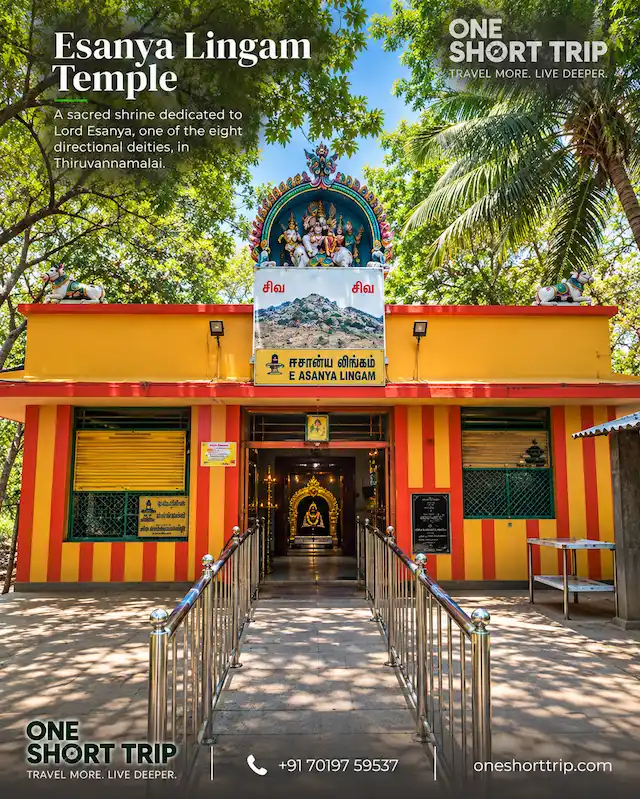
Eesanya Lingam
Discover Eesanya Lingam, one of the eight sacred Ashta Lingams along the Girivalam path around Arunachala Hill in Tiruvannamalai.
Esanya Lingam Temple, Tiruvannamalai – The Eighth Lingam of Girivalam
Esanya Lingam, also known as Eesanya Lingam or Eesaniyalingam, is one of the eight sacred Shiva Lingams located around Arunachala Hill in Tiruvannamalai, Tamil Nadu. It represents the northeast direction and is traditionally recognised as the eighth and final Lingam in the Ashta Lingam sequence followed by devotees during Girivalam.
Dedicated to Lord Shiva, this shrine forms an important part of the spiritual circuit around the sacred Arunachala Hill. Pilgrims undertaking Girivalam traditionally visit the eight Lingams in sequence, offering prayers at each shrine as they circumambulate the hill.
Esanya Lingam holds a special place as the final shrine in this sequence. Its association with the northeast direction and the traditional connection with Budhan (Mercury) add to its religious significance for devotees.
Quick Information About Esanya Lingam Temple
Here are the essential details to help you understand the temple's location, direction, religious association and visiting hours before planning your Girivalam pilgrimage.
What Is Esanya Lingam Famous For?
Esanya Lingam is primarily known as the eighth and final Shiva Lingam in the Ashta Lingam circuit around Arunachala Hill. Its position in the northeast direction gives it a distinct place in the traditional arrangement of the eight directional shrines.
Devotees visit this temple as part of their Girivalam pilgrimage, completing the sequence of prayers at the eight Lingams. The shrine is also traditionally associated with Budhan, or the planet Mercury, in devotional and astrological interpretations.
Key Reasons Devotees Visit
- To offer prayers at the eighth and final Ashta Lingam.
- To complete the traditional sequence of eight directional Shiva shrines during Girivalam.
- To worship Lord Shiva in the form of Esanya Lingam.
- To seek spiritual calmness and clarity through prayer and devotion.
- To offer prayers in connection with the traditional Budhan (Mercury) association.
For many pilgrims, visiting Esanya Lingam is a meaningful part of completing the sacred walk around Arunachala Hill. The significance of the shrine is best understood within the wider spiritual tradition of Girivalam.
Where Is Esanya Lingam Temple Located?
Esanya Lingam Temple is situated along the Girivalam path around Arunachala Hill in Tiruvannamalai, Tamil Nadu. The official temple listing identifies it as Arulmigu Eesaniya Lingam Temple, located on Girivalam Path, Tiruvannamalai – 606601.
The shrine is positioned in the northeast direction of the sacred hill and is recognised as the final Lingam in the traditional Ashta Lingam sequence. Pilgrims generally visit it as they progress through the Girivalam circuit.
Temple Address
Arulmigu Eesaniya Lingam Temple
Girivalam Path,
Tiruvannamalai,
Tamil Nadu – 606601.
Visitors travelling from outside Tiruvannamalai can first reach the town by road or rail and then proceed towards the Girivalam route. Local transport and directions from residents can help identify the shrine entrance.
Story and Legend of Esanya Lingam
The spiritual identity of Esanya Lingam is connected with the traditional understanding of the eight directions and their guardians in Hindu belief. The northeast direction is known as Esanya, and the Lingam placed in this direction is worshipped as part of the sacred arrangement around Arunachala Hill.
In Hindu traditions, the eight directional guardians are associated with different regions of the universe. The Ashta Lingams around Arunachala are understood within this sacred framework, with each shrine representing a particular direction.
Esanya Lingam occupies the northeast position and completes the sequence after Indra, Agni, Yama, Niruthi, Varuna, Vayu and Kubera Lingams. Its place at the end of the circuit gives it special importance for devotees who visit all eight shrines during Girivalam.
History of Esanya Lingam Temple
Esanya Lingam is part of the long-standing religious landscape associated with Arunachala Hill and the Girivalam pilgrimage in Tiruvannamalai. The eight directional Lingams have an established place in the traditional pilgrimage circuit followed by devotees around the sacred hill.
The Tiruvannamalai District Administration recognises Esanya Lingam as the eighth Lingam in the Girivalam sequence. The shrine is also listed separately by the Tamil Nadu Hindu Religious and Charitable Endowments Department under the name Arulmigu Eesaniya Lingam Temple.
However, a reliable construction date, original architectural chronology or detailed account of the shrine's earliest development is not established in the official information consulted for this page. It would therefore be misleading to assign a specific period or historical event without supporting evidence.
What Can Be Established
- The shrine is officially listed as Arulmigu Eesaniya Lingam Temple.
- It forms part of the Ashta Lingam pilgrimage tradition around Arunachala Hill.
- It is recognised as the eighth and final Lingam in the Girivalam sequence.
- It is situated on Girivalam Path in Tiruvannamalai.
Who Built Esanya Lingam Temple?
The original builder or patron responsible for establishing Esanya Lingam Temple has not been reliably identified in the official temple information available for this page.
Although the shrine is part of the ancient religious tradition surrounding Arunachala Hill, its exact construction date, founding patron and individual phases of development should not be attributed to a particular king, dynasty or historical figure without dependable inscriptional or documentary evidence.
The temple is currently listed under the Tamil Nadu Hindu Religious and Charitable Endowments Department, which provides official information about its address, opening hours and pooja schedule.
Presiding Deity of Esanya Lingam Temple
The presiding deity of Esanya Lingam Temple is Lord Shiva, worshipped in the form of a Shiva Lingam. The name Esanya refers to the northeast direction, which gives the shrine its identity within the eight directional Lingams around Arunachala Hill.
In the Ashta Lingam tradition, each shrine is associated with a direction and its corresponding guardian. Esanya Lingam represents the northeast and is traditionally connected with Ishana, a form or aspect associated with Lord Shiva.
Lord Shiva as Esanya Lingam
Devotees offer prayers to the Shiva Lingam seeking divine grace, inner peace and spiritual well-being. The shrine's significance comes from both its worship of Lord Shiva and its position as the final Lingam in the Girivalam sequence.
Esanya Lingam is also traditionally associated with Budhan (Mercury) in the planetary interpretation of the Ashta Lingams. This is a devotional association and should be understood separately from the identity of the presiding deity, who remains Lord Shiva.
Religious and Spiritual Significance of Esanya Lingam
Esanya Lingam holds an important place in the spiritual tradition of Tiruvannamalai as the eighth and final Lingam in the Ashta Lingam circuit. Devotees visit this shrine while completing Girivalam, the sacred circumambulation of Arunachala Hill.
The northeast direction, known as Esanya, is traditionally regarded as spiritually significant in Hindu belief. The shrine's association with this direction gives it a distinct identity among the eight directional Lingams.
Why Devotees Offer Prayers Here
- To worship Lord Shiva at the final shrine in the Ashta Lingam sequence.
- To complete their traditional prayers at all eight directional Lingams.
- To seek peace of mind, spiritual strength and divine blessings.
- To pray in connection with the northeast direction and its traditional spiritual significance.
- To include Esanya Lingam in their personal Girivalam pilgrimage.
Devotional benefits are matters of personal faith and tradition. Visitors may offer prayers according to their beliefs and the temple's accepted worship practices.
Esanya Lingam and Its Association with Budhan (Mercury)
Esanya Lingam is traditionally associated with Budhan, the planet Mercury, in the planetary interpretation of the eight Lingams around Arunachala Hill. This association is part of the devotional and astrological traditions connected with the Ashta Lingams.
In Hindu astrology, Budhan is commonly associated with intelligence, communication, learning, reasoning and analytical ability. Devotees who follow these traditions may offer prayers at Esanya Lingam seeking divine blessings in matters connected with these qualities.
Traditional Associations of Budhan
- Education, learning and knowledge.
- Communication and expression.
- Intelligence and analytical thinking.
- Business, trade and practical decision-making.
Worship and Offerings at Esanya Lingam Temple
Devotees visiting Esanya Lingam generally offer prayers to Lord Shiva as part of their Girivalam pilgrimage. The worship experience is centred on the Shiva Lingam, with visitors following the customary practices permitted at the shrine.
Simple devotional offerings and prayers are suitable for pilgrims who wish to visit the temple as part of their spiritual journey. Specific pooja services and offerings should be confirmed with the temple authorities before making arrangements.
Common Devotional Practices
- Offering prayers and seeking blessings from Lord Shiva.
- Lighting a lamp where permitted by the temple.
- Offering flowers or other accepted devotional items.
- Participating in the temple's scheduled pooja when available.
- Spending a few quiet moments in prayer and meditation.
Esanya Lingam Temple Timings
According to the Tamil Nadu Hindu Religious and Charitable Endowments Department listing, Esanya Lingam Temple follows morning and evening visiting sessions. The temple remains closed during the afternoon break.
| Session | Temple Timings |
|---|---|
| Morning | 6:00 AM – 12:00 PM |
| Afternoon | Closed |
| Evening | 4:00 PM – 8:00 PM |
The official listing also mentions Kalasandhi pooja during the morning session, between 6:00 AM and 7:00 AM.
Best Time to Visit Esanya Lingam Temple
Esanya Lingam can be visited throughout the year during its published opening hours. The most suitable time depends on whether you prefer a quieter temple visit, a morning pilgrimage or the devotional atmosphere of a special occasion.
Early Morning
The morning session is suitable for devotees who prefer to begin their temple visits early. It can also be a convenient time to continue with other shrines along the Girivalam route.
Evening
The evening session provides another opportunity to visit the shrine. Plan your arrival before the closing time and allow sufficient time for prayers.
October to March
Many visitors prefer the cooler months for travelling around Tiruvannamalai and undertaking outdoor sightseeing or the Girivalam walk.
Pournami Days
Full-moon days attract large numbers of Girivalam pilgrims. The atmosphere is devotional, but visitors should expect heavier crowds and plan accordingly.
Festivals and Special Days to Visit Esanya Lingam
Esanya Lingam is part of the wider Arunachaleswarar and Girivalam pilgrimage tradition. Special religious occasions in Tiruvannamalai bring increased devotional activity around Arunachala Hill and its associated shrines.
Important Occasions
- Pournami: Full-moon days are particularly significant for Girivalam, when large numbers of devotees walk around Arunachala Hill and visit the eight Lingams.
- Karthigai Deepam: One of the most important annual festivals of Tiruvannamalai, attracting pilgrims from many parts of India.
- Maha Shivaratri: A major occasion dedicated to Lord Shiva, observed by devotees through prayer and worship.
- Pradosham: A recurring auspicious occasion for Shiva worship, observed twice in a lunar month.
- Monthly and special temple observances: Other poojas and religious occasions may be observed according to the temple calendar.
During major festivals, the town and Girivalam route can become exceptionally busy. Accommodation, parking and local transport may require advance planning.
How to Reach Esanya Lingam Temple, Tiruvannamalai
Esanya Lingam is located on the Girivalam path in Tiruvannamalai. Travellers from other cities should first reach Tiruvannamalai and then use local transport or proceed along the pilgrimage route to reach the shrine.
By Road
Tiruvannamalai is connected by road with major towns and cities in Tamil Nadu and neighbouring states. Buses, private cars and tourist vehicles are commonly used by pilgrims travelling to the town.
Visitors arriving by car can proceed towards the Girivalam route and follow local directions to the temple. Parking availability may vary depending on the day and crowd conditions.
By Train
Tiruvannamalai has a railway station. Travellers can check train services from their departure city and use an auto-rickshaw, taxi or other local transport to reach the Girivalam route.
By Bus
State-run and private bus services connect Tiruvannamalai with several towns and cities. From the bus stand, visitors can arrange local transport to reach the shrine.
From Bengaluru
Travellers from Bengaluru can reach Tiruvannamalai by road using a private vehicle, cab or bus service. The journey time depends on the chosen route, traffic and road conditions.
For a planned pilgrimage covering all eight Lingams and the main Arunachaleswarar Temple, arranging transport in advance can make the visit more comfortable.
Where Is Esanya Lingam Located on the Girivalam Route?
Esanya Lingam is the eighth and final shrine in the traditional Ashta Lingam sequence around Arunachala Hill. It represents the northeast direction and follows Kubera Lingam, which represents the north.
Devotees traditionally visit the eight directional Lingams while completing the approximately 14-kilometre Girivalam circuit. The exact order and starting point may depend on the customary route followed by the pilgrim.
| Sequence | Lingam | Direction |
|---|---|---|
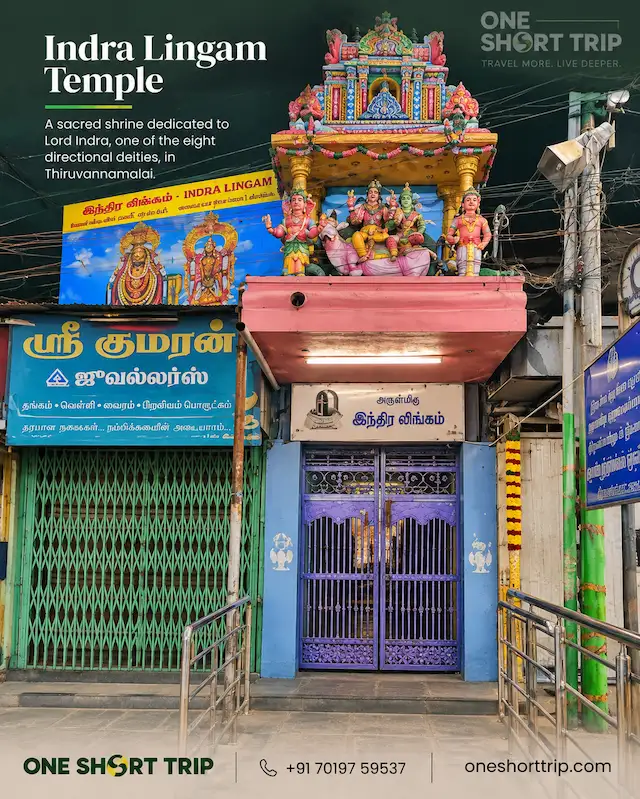
| 1 | Indra Lingam | East |
| 2 | Agni Lingam | Southeast |
| 3 | Yama Lingam | South |
| 4 | Niruthi Lingam | Southwest |
| 5 | Varuna Lingam | West |
| 6 | Vayu Lingam | Northwest |
| 7 | Kubera Lingam | North |
| 8 | Esanya Lingam | Northeast |
You can also explore the other shrines in the circuit:
Nearby Temples and Places to Visit Near Esanya Lingam
A visit to Esanya Lingam can be combined with other important spiritual and cultural places in Tiruvannamalai. Depending on your available time, you can explore the main temple, other shrines around Arunachala Hill and places associated with the town's spiritual heritage.
Arunachaleswarar Temple
One of the most important Shiva temples in Tamil Nadu, Arunachaleswarar Temple is dedicated to Lord Arunachaleswarar and Goddess Unnamulai Amman. Its towering gopurams, large temple complex and association with Arunachala make it a major pilgrimage destination.
Adi Annamalai Temple
Adi Annamalai Temple is an important shrine associated with the spiritual landscape of Arunachala. It is also visited by pilgrims undertaking the Girivalam pilgrimage.
Other Ashta Lingam Shrines
The other seven directional Lingams are important stops for devotees wishing to complete the traditional Ashta Lingam pilgrimage. They can be visited as part of the wider Girivalam route.
Ramanasramam
Located at the foothills of Arunachala, Sri Ramanasramam is associated with the life and teachings of Sri Ramana Maharshi. Visitors interested in meditation and spiritual history may include it in their Tiruvannamalai visit.
One-Day Tiruvannamalai Temple Visit Plan
If you have one full day in Tiruvannamalai, you can plan a combination of the main Arunachaleswarar Temple, the Ashta Lingam shrines and other nearby spiritual places. The following is a suggested sequence, not a fixed temple schedule.
| Suggested Time | Visit Plan |
|---|---|
| 6:00 AM – 7:30 AM | Begin the day with an early temple visit, subject to opening hours and crowd conditions. |
| 7:30 AM – 9:00 AM | Breakfast and proceed towards the Girivalam route. |
| 9:00 AM – 12:00 PM | Visit selected Ashta Lingam shrines, including Esanya Lingam, depending on travel time and access. |
| 12:00 PM – 2:30 PM | Lunch and rest during the afternoon temple closure. |
| 2:30 PM – 5:00 PM | Visit Adi Annamalai or Ramanasramam, allowing for local travel and visiting hours. |
| 5:00 PM – 7:30 PM | Continue with the evening temple visit or additional shrines, subject to their opening hours. |
For a more detailed plan covering the temples, travel arrangements and practical information, visit our Tiruvannamalai Travel Guide.
Why Visit Abhaya Anjaneya Swamy Temple?
Frequently Asked Questions About Esanya Lingam Temple, Tiruvannamalai
1. Where is Esanya Lingam Temple located?
Esanya Lingam Temple is located on the Girivalam path around Arunachala Hill in Tiruvannamalai, Tamil Nadu. It is one of the eight sacred Shiva Lingams situated around the hill.
2. Which direction does Esanya Lingam represent?
Esanya Lingam represents the northeast direction. It is the eighth and final Lingam in the traditional Ashta Lingam sequence around Arunachala Hill.
3. What is Esanya Lingam famous for?
Esanya Lingam is famous for its position as the final shrine in the Ashta Lingam circuit. Devotees visit it as part of their Girivalam pilgrimage and offer prayers to Lord Shiva.
4. Who is the presiding deity of Esanya Lingam Temple?
Lord Shiva is the presiding deity, worshipped in the form of a Shiva Lingam. The name Esanya refers to the northeast direction.
5. Is Esanya Lingam the eighth Lingam in Girivalam?
Yes. Esanya Lingam is traditionally recognised as the eighth and final Lingam in the Ashta Lingam sequence around Arunachala Hill.
6. Which planet is associated with Esanya Lingam?
Esanya Lingam is traditionally associated with Budhan, or Mercury, in the planetary interpretation of the eight Lingams. This is a religious and astrological belief.
7. What are the spiritual benefits of worshipping Esanya Lingam?
Devotees visit the shrine seeking Lord Shiva's blessings, peace of mind and spiritual well-being. Those who follow the traditional Budhan association may also offer prayers concerning education, communication and intelligence. These are matters of faith.
8. What are the opening timings of Esanya Lingam Temple?
According to the Tamil Nadu HR&CE listing, the temple is open from 6:00 AM to 12:00 PM and from 4:00 PM to 8:00 PM. It remains closed during the afternoon break.
9. Is there a morning pooja at Esanya Lingam Temple?
The official temple listing mentions Kalasandhi pooja between 6:00 AM and 7:00 AM. Visitors should confirm the current pooja schedule locally before planning a visit around it.
10. How much time is required to visit Esanya Lingam?
The time required depends on the crowd, waiting time and personal prayer routine. Visitors making a short stop can plan a brief visit, while those undertaking a complete Girivalam pilgrimage should allow additional time for the other seven Lingams.
11. Can I visit Esanya Lingam during Girivalam?
Yes. Esanya Lingam is one of the eight directional shrines traditionally visited during Girivalam around Arunachala Hill. It is the final Lingam in the customary sequence.
12. How long is the Girivalam route in Tiruvannamalai?
The full Girivalam route around Arunachala Hill is approximately 14 kilometres. The actual distance covered may vary depending on the starting point and route followed.
13. What is the best time to visit Esanya Lingam Temple?
Early morning and evening are convenient times to visit during the temple's published opening sessions. October to March is generally preferred by many travellers for outdoor sightseeing and walking because of the relatively cooler weather.
14. Can I visit Esanya Lingam on Pournami?
Yes. Many devotees visit the Ashta Lingams during Pournami as part of their Girivalam pilgrimage. However, full-moon days can attract large crowds, so allow extra time for travel, darshan and local movement.
15. Is Esanya Lingam suitable for senior citizens?
Senior citizens can visit the shrine, subject to their mobility and the conditions on the day. Those who find long walks difficult may prefer to arrange local transport where permitted and avoid attempting the entire Girivalam walk without considering their physical comfort.
16. Can I visit Arunachaleswarar Temple and Esanya Lingam on the same day?
Yes. Visitors can plan both shrines on the same day, subject to opening hours and crowd conditions. Allow sufficient time for travel between locations and for temple visits.
17. Can I visit all eight Lingams in one day?
Yes, it may be possible to visit all eight Lingams in one day, depending on the chosen mode of travel, temple access, traffic and crowd conditions. Completing the full Girivalam walk on foot requires more time and physical effort.
18. Is there an entry fee at Esanya Lingam Temple?
General entry-fee details could not be independently confirmed from the official information consulted for this page. Visitors should check with the temple authorities for any current charges or special pooja arrangements.
19. What are the other temples near Esanya Lingam?
Important places to include in a Tiruvannamalai visit are Arunachaleswarar Temple, Adi Annamalai Temple and the other seven Ashta Lingam shrines. Sri Ramanasramam is another significant spiritual destination in the town.
20. Is Esanya Lingam the same as Arunachaleswarar Temple?
No. Esanya Lingam is a separate Shiva shrine on the Girivalam path and forms part of the eight directional Lingams. Arunachaleswarar Temple is the major Shiva temple in Tiruvannamalai dedicated to Lord Arunachaleswarar and Goddess Unnamulai Amman.
You May Also Like


Planning A Trip Here?
Get help planning your visit — call or WhatsApp us and we will help you book a tour.